TL;DR
The failure of two large cardiovascular trials does not invalidate the inflammation hypothesis but shows the mistake of relying on surrogate blood markers like hs-CRP and Lp(a) that decouple from actual coronary inflammation.
Two closely watched cardiovascular drug trials just failed: an anti-inflammatory drug didn't cut heart attacks, and neither did a drug that lowers Lp(a). The press was quick to declare the 'inflammation hypothesis' dead. But Eric Topol argues the real problem was the trial design — they measured the wrong thing.
Blood inflammation is not artery inflammation
With no way to look directly at inflamed coronary arteries, doctors relied on blood markers like hs-CRP or IL-6. The trouble: any inflammation anywhere in the body — arthritis, a cold — raises those levels. They aren't specific.
The ZEUS trial enrolled people with chronic kidney disease, who tend to have elevated inflammatory markers whether or not their arteries are inflamed. When perhaps half of the participants never had coronary inflammation to begin with, any treatment effect gets washed out.
A new tool: AI reads coronary inflammation from a CT scan
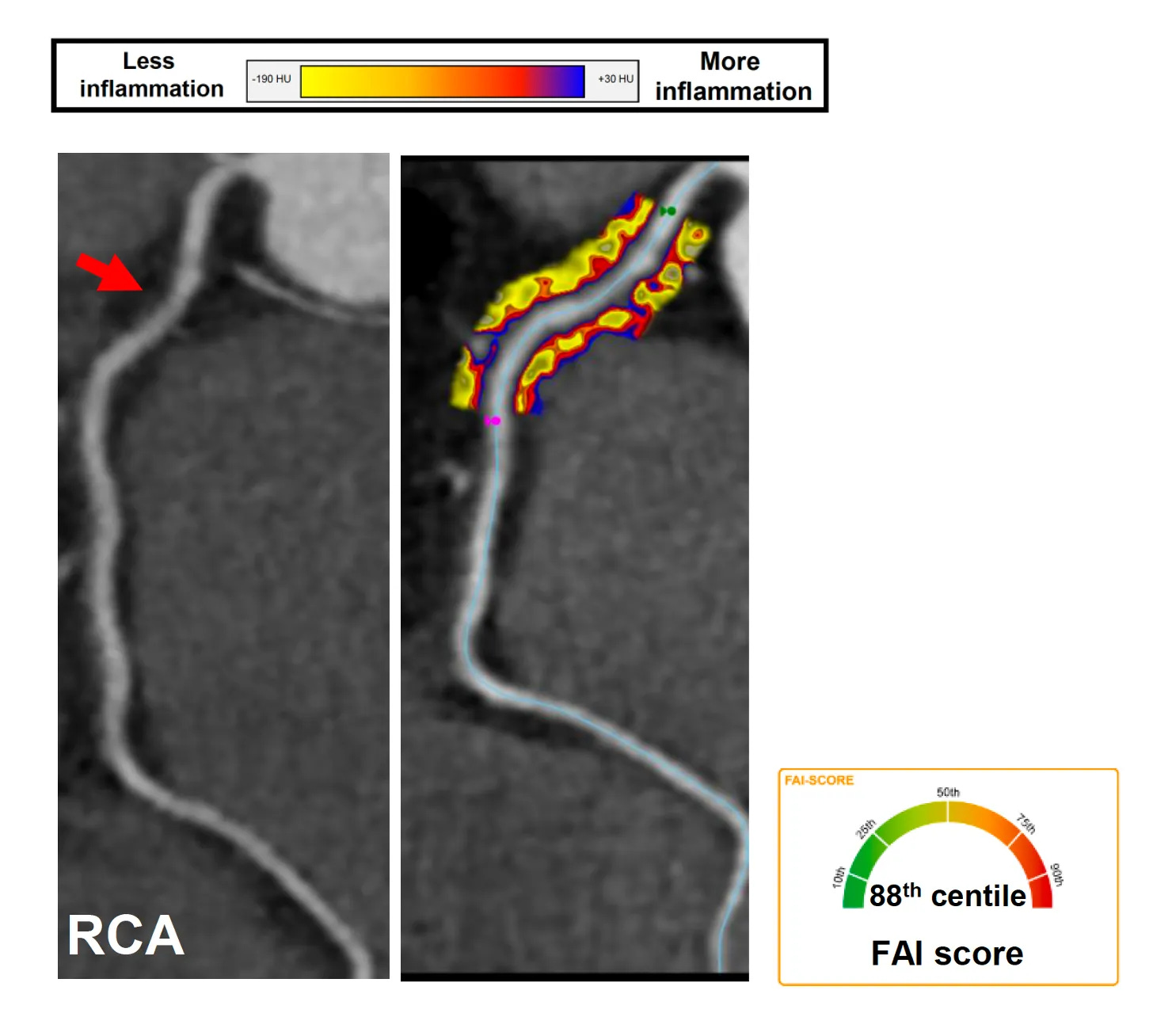
The Oxford team built the fat attenuation index (FAI), which uses AI on a standard chest CT to score each coronary artery for inflammation. They found that hs-CRP correlates only weakly with FAI — r=0.2, almost nothing.
FAI isn't just theoretical. It's FDA-cleared, and an inflamed artery predicts cardiac death with a hazard ratio of 13 — up to 30 if all three vessels are inflamed. Far more useful than any blood test.
Lp(a) is also a blurry metric
Lp(a)'s danger comes largely from the oxidized phospholipids it carries, yet blood tests measure particle number, ignoring OxPL entirely. Two people with the same Lp(a) can have wildly different arterial inflammation. Fixating on the number alone is like touching only the elephant's tail.
Topol's bottom line: don't discard the inflammation hypothesis. The next trials should screen participants with a cheap chest CT and enroll only those who actually show coronary inflammation. Only then can a drug's true effect be seen.
Curated from high-quality sources, with concise summaries and key takeaways.

