Scientists walk through what a Yellowstone super-eruption would actually look like hour by hour — from the first swarm of tiny quakes to global food prices and a decade of ash — and find that the hard part is not the magma but moving twenty million people.
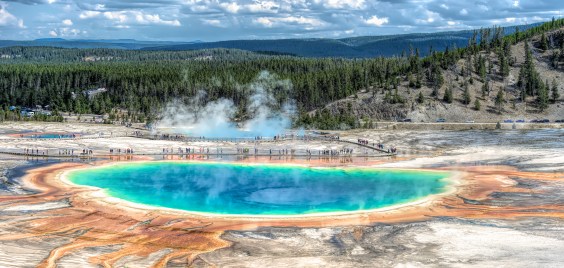
The first thing it wakes up is a room full of seismometers
Yellowstone is not a bomb quietly ticking underground. Scientists have wired the park with dense seismometers, GPS stations and strainmeters, all watching the ground breathe around the clock.
Two months out, the monitoring station sees a small cluster of odd earthquakes. Far too weak to feel, but they sit at shifting depths and appear to be creeping upward — a sign that hot fluids or magma are pushing their way up.
Yellowstone has done this before. Between 2013 and 2014 parts of the caldera rose more than 15 centimetres in a year, then produced nothing worse than a magnitude 4.8 quake.
The alert goes up, and then the maths gets ugly
A month later the quakes are shallower, the ground is lifting faster, and Old Faithful stops being faithful. The alert level moves from normal to advisory, and the modelled chance of an eruption within three months jumps from 6-9% to 21-27%.
Two weeks after that it reaches 85-92%. Officials announce an evacuation zone extending 100 kilometres beyond the park, covering roughly 200,000 residents plus thousands of visitors.
Moving people is one problem. Housing, water, food, electricity, schools and jobs for all of them is another. Countries asked to take in volcano refugees will mostly say they have no room and no money.
The poorest and most marginalised tend to be the ones left behind.
When it finally goes, magma is not the main killer
The caldera does not explode all at once. Magma intrudes into the shallow hydrothermal system and flashes enormous volumes of water into steam — which expands roughly 1,700-fold — blasting steam, mud and shattered rock kilometres into the air.
Then magma at 650-800°C breaks through the surface, throwing a column 30-50 kilometres up, visible from Denver, 800 kilometres away.
Where pyroclastic flows sweep through, trees and people go together. Perhaps a thousand die immediately, most bodies unrecoverable. Further out, the deaths come from car crashes, power failures, respiratory illness and suicide.
Billings, Montana, could end up under more than a metre of ash. Power and water fail, shelves empty, airports close again and again.
What actually grinds the world down is the decade after
Months later the eruption weakens, but wind keeps lifting the ash, and people with asthma go first. American and Canadian grain exports vanish, global food prices spike, banks and insurers buckle, and the world slides into recession.
Sulphur dioxide in the stratosphere reflects sunlight. Global average cooling probably stays under 1.5°C, though central North America gets much colder.
Ten years on, people relearn potatoes, grains and legumes. Meat shrinks, insect farming grows. The number without safe freshwater may rise from 4.4 billion to 4.8 billion, while the population may fall from 8.3 billion to 7.9 billion.
Silicosis and lung cancer diagnoses tick upward, and a collapsed health system turns treatable cases fatal.
The authors' estimate of excess deaths runs to 700 million to 1.3 billion. The volcano does not end humanity, or come close. It just redraws the planet.
Why it matters
What makes this thought experiment unnerving is not the volcano but the reaction chain: the warning window is long enough to reveal that countries will probably hoard, stall and point fingers. Magma was never the unsolvable part — human coordination is.


Curated from high-quality sources, with concise summaries and key takeaways.

