
Daily Takes
All
10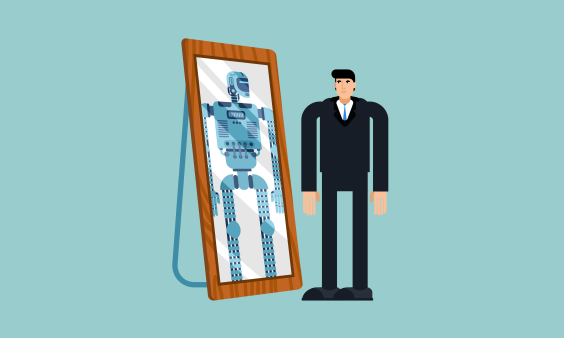
Are You in Danger of Becoming a Robot?
Frequent interaction with social robots can subtly reshape people's expression and identity to fit AI's capabilities, resulting in a diminished sense of personhood.
You might think mimicking robots is just for laughs—Charlie Chaplin in Modern Times couldn't stop turning bolts after leaving the assembly line, and robot dance videos are all over TikTok. But research suggests that chatting too much with social bots might genuinely make people more robot-like.
1. Not replaced, but tamed
Researchers call this 'robotoid humanness.' The risk isn't that people mistake bots for humans or turn into machines; it's that people slowly adjust themselves to make it easier for AI to understand them.
For instance, people change the way they speak to voice assistants, craft resumes purely to pass software filters, and writers avoid certain words to escape AI detection.
2. Why AI rewires you
Human friends push back, offer surprises, and help you grow. But social bots are designed to keep you engaged by always agreeing with you, offering 'frictionless alignment.'
This pseudo-intimacy nudges people to become more consistent and predictable, shrinking room for self-reflection and growth.
3. Who is most at risk
The lonely, sick, very young, or those having a hard time are most vulnerable. A warm, attentive companion available at 3 a.m. is hard to resist.
The study warns that as AI saturates daily life, this 'reduced personhood' could become normal. Though theoretical, the authors caution: don't let robots define who you are.
Are we watching the U.S. go bankrupt?
美国长期利率的小幅上升并不等于债务危机,但巨额债务和财政政策仍需警惕。
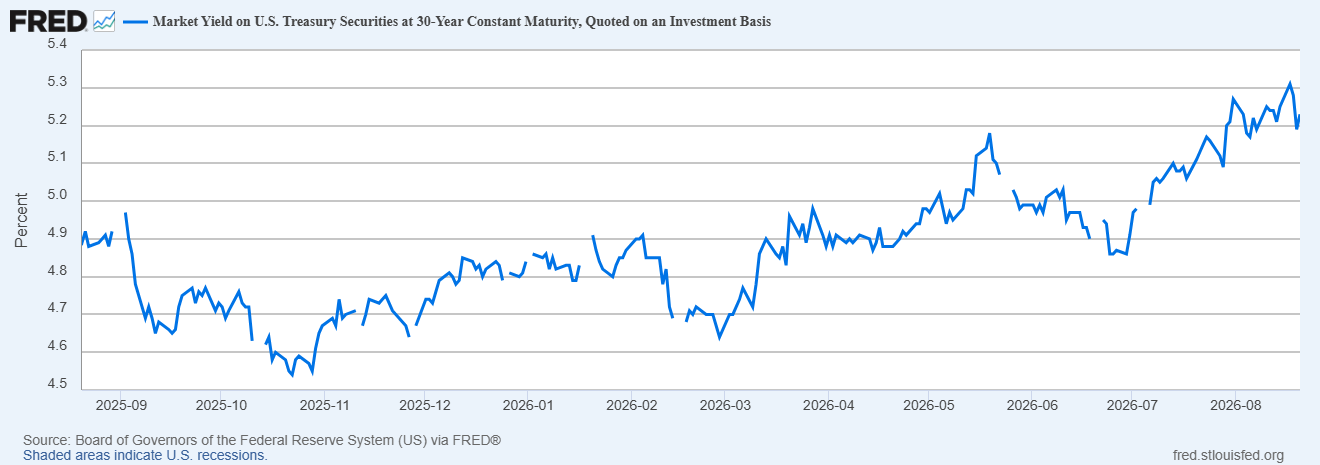
最近美国30年期国债收益率涨了6个基点(0.06%),很多人慌了。利率上涨意味着债券价格下跌,买的人少了,这可能是通胀预期或对政府信心下降的信号。
但先别急着喊“美国破产”,其实涨幅很小。除了日本,全球利率上涨主要发生在2021-2023年,2026年以来的涨幅只有零点几个百分点。
1. 债市“义警”盯上了美国?
有些投资者担心美国政府还不起债,要求更高的风险溢价,被称为“债市义警”。他们可能被飙升的债务和赤字吓到。但根据数据,这还远没到危机。
2. 政府出手“救市”,但市场不买账
特朗普政府宣布买长期国债来压低利率,结果只管用了一天,30年期收益率又涨回5.27%。这说明市场信心没那么容易扭转。
3. 真相:涨幅太小,不足为惧
长期利率的上涨分为三阶段:2019年下跌,2022-2023年大涨,2026年只是小波动。所以,虽然美国债务问题值得长期关注,但这次利率上升只能让人多担心一点点。
一句话:别看衰美国,但债务问题也别忽视。

Your Book Review: A Residence Of 21 Years In The Sandwich Islands
Re-reading her ancestor Hiram Bingham's memoir, the author finds 19th-century missionaries and today's effective altruists think alike, and their wins and losses still carry lessons.
In 1819, the author's great-great-great-grandfather Hiram Bingham and his wife Sybil set sail from Boston for the Hawaiian Islands. Their goal was not profit but salvation: to lift islanders from 'barbarism' to 'civilisation' and Christianity.
To the author, this looks a lot like today's effective altruism (EA) — both ask 'how to do the most good with the resources at hand.' For Hiram, though, the good depended on whether islanders could avoid eternal damnation.
1. A charitably perfect target
Hawaii looked like an ideal 'cause area': sizable population, little competition from other missionaries or existing religions, and low cost — just a ship, a printing press, and teachers.
They arrived just as the local religion was collapsing: King Kamehameha I had died, and the regent queen abolished the kapu taboo system that restricted women. The missionaries half-finished their work.
2. Speedrunning civilisation: school, press, plus dresses and houses
Hiram and colleagues pushed a 'civilisation package': they set up schools, invented a Hawaiian alphabet, and started printing. In a few years, a third of islanders became literate — a higher share than in many European countries at the time.
They also brought 'modern' living: American-style houses with chimneys, and new dresses became fashionable. As Hiram wrote, first show you can build a house or make a coat; then the islanders will listen to your teachings.
3. Win by politics, lose by politics
To boost influence, Hiram allied with Queen Ka'ahumanu, helped her against political rivals, and through her banned Catholicism, alcohol, and hula dancing. But this violated the mission board's rule against political meddling.
In 1839, a French frigate arrived with guns and an ultimatum demanding Catholic freedom and a $20,000 payment. Hawaii had to give in, and the board, fed up, recalled Hiram.
Afterword: the missionary's legacy
Despite recall, many of Hiram's goals had been met: 60% of Hawaiians became Christian, and his spelling system still writes the Hawaiian language today.
But the next fifty years were harsh: disease and land grabs cost Hawaiians their kingdom, the Bayonet Constitution of 1887, and the monarchy fell in 1893.
The author's take: modern idealists can learn from Hiram's courage, leading by example, and making allies — but watch out for political entanglement and overconfidence. Most of all, don't annoy the French.
AI-Generated Images Can Perform as Well as Stock Photography
When users don't know an image's provenance, AI-generated photos are judged no less trustworthy than real stock photography; trust depends more on content than on how it was made.
Many companies worry that using AI-generated images will make them look unprofessional or untrustworthy. But new research says: as long as users aren't told the image is AI-made, they can't tell the difference and don't judge it more harshly.
The authors recruited 77 Americans to rate a fictional consulting firm's website. The sites were identical except for the hero image: 3 generated by AI, 3 real photographs. Users rated the company on trustworthiness, professionalism, and authenticity after viewing each page.
Surprise: AI images scored at least as high on all three dimensions, slightly higher in fact. Only 'authenticity' showed a statistically significant gap — but it was a mere 0.4 points on a 7-point scale. In open comments, praise focused on 'teamwork,' and criticism on 'lack of diversity' or 'hierarchy in poses' — nothing to do with image source.
Diversity is what matters
What users repeatedly cared about was 'diversity.' One AI image won praise for feeling 'inclusive,' while a real photo was criticized for not being 'diverse enough.' So AI doesn't automatically produce inclusive imagery — teams must manually check who leads, who supports, and whether stereotypes sneak in.
A few users suspected an image was AI-generated, and whenever they did, their ratings dropped — even when the image was actually real. That suggests the risk lies in being caught, not in using AI itself.
Screen AI images before use
The takeaway: AI images can be design assets, but not all are ready for prime time. Before using one, check: Does it support the page's message? Does representation look inclusive? Is the scene believable? Are there AI glitches in hands, text, glass reflections? How does it look at actual size on the page?
Also mind legal and ethical issues: AI models may have been trained on real people's photos, so check the tool's copyright policy. In the end, image source matters less than whether the image works — at least until users learn the source is AI.
‘Huge Breakthrough’ in the Math of Imbalance
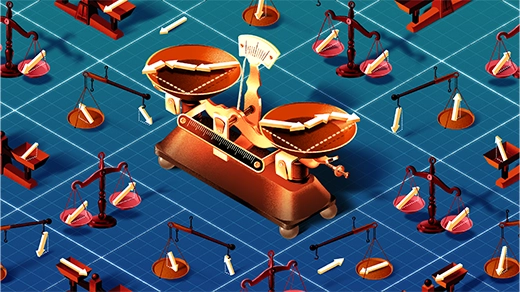
Computer scientists have made the first major advance in 30 years on the Komlós conjecture, showing that even with huge numbers of objects and attributes, imbalance can be kept almost constant.
Splitting a group of people with different strengths into two evenly matched teams sounds like everyday trivia, but it's actually a hard math problem.
1. Not just people: cars, drugs, and more
Mathematicians study 'discrepancy' — how uneven a split is, like dividing used cars between two lots or trial participants into treatment and placebo groups.
In the 1980s, mathematician János Komlós conjectured that no matter how many objects or attributes, discrepancy has a universal upper bound. Even he called it 'irresponsible'.
2. Random splits blow up; algorithms tame them
A naive random split makes discrepancy grow with the number of objects N. The best 1998 result capped it at log N.
In 2010, computer scientist Nikhil Bansal devised an algorithmic approach, and by 2025, with Haotian Jiang, he pushed the bound down to the fourth root of log N — for N equal to the number of atoms in the universe, that's only 3.
3. Why it matters
This nearly constant bound is the first improvement in decades, boosting confidence that Komlós was right. The algorithm also has implications for machine learning and optimization.
In short: what seemed impossible is now within reach.

Pluralistic: Born on technology's third base (21 Aug 2026)
The success of the AI industry relies not just on talent but on historical luck—the coincidence of massive parallel computing and internet data—much like being born on third base.
Many credit AI's rise to genius and hard work, but the author argues that AI was 'born on third base'—its success owes much to historical accident.
1. Luck is part of the game
The author cites himself: born in 1971 to a computer-scientist father, he grew up surrounded by tech. Education was cheap, tech was booming, and he walked into a career. He notes that boomers who bought starter homes and watched them soar think they're Warren Buffett, but the smart ones know they got lucky.
2. AI's perfect timing
Computing shifted from Moore's law to parallel processing, with GPUs doubling in power yearly. Simultaneously, the internet amassed trillions of documents. Together, they enabled 'theory-free inference'—finding correlations without understanding causes. It worked spectacularly, but it has limits: it can predict patterns but fails at the unexpected. An LLM can recite chess rules but can't play legally.
3. Don't mistake luck for permanence
The author warns that AI companies believe 'scale can replace understanding,' but many tasks are better done with conventional programs. Just as post-war suburbs can't fix the 2026 housing crisis, pouring trillions into AI won't solve what it's bad at. Success may be contingent, and the bubble may pop.

Collections: Pre-Modern Armies for Worldbuilders, Part Vb: Pixel Armies for Pixel Societies
Armies in video games often feel off because they ignore the society behind them; good military design must mirror the political and economic structures of its world.
Video game armies look plausible at first glance, but on closer inspection they often fall apart. Why? Because armies don't materialize out of thin air — they have to fit the society that fields them.
Let's break down a few classic games:
1. The Imperial Legion: professional armies need real money
The Imperial Legion in The Elder Scrolls is a professional standing army with uniform equipment and long service. That's wildly expensive and requires substantial tax revenue to sustain.
Yet the game's tax system is nearly invisible, leaving just a trading company to fund the state — clearly not enough. In an agrarian society, tax revenue must come from the land, but the game never shows that.
2. Trading company armies: private military contractors
The Vailian Trading Company in Pillars of Eternity II is a textbook case of private enterprise war. The company hires mercenaries, and their leaders can subcontract further.
That model fits the company's decentralized structure, but the game features only one major contractor, which feels lonely. In reality, such companies would have layers of subcontracting.
3. Baldur's Gate: army vs. society
Baldur's Gate's military setup is even more awkward. A city-state should rely on a militia, but instead its main defense is a mercenary company on permanent retainer.
And the company's marshal is also one of the city's four grand dukes — that political structure is a powder keg. Whoever commands the army rules the city, so this setup heads straight for tyranny.
In one line: a good military design reflects its society. Designing an army is really designing the social structure behind it.

Great Scott
US Treasury Secretary Bessent calls himself the nation's top bond salesman, but recent auction yields have surged to multi-year highs, suggesting his sales performance is slipping.
US Treasury Secretary Scott Bessent turned 64 today, but instead of gardening, he has been busy intervening in bond markets. To stem rising yields, he announced the department would ramp up purchases of longer-dated government securities.
Bessent sees himself as 'the nation's top bond salesman', having issued $30.2 trillion in marketable securities in fiscal 2025. He touted in November that 'the Treasury market remains the deepest and most liquid market in the world', but by his own yardstick, his performance has been slipping.
1. Auction yields surge
On August 12, a $42 billion auction of 10-year notes saw yields hit 4.683%, the highest since 2007; the next day, a $25 billion sale of 30-year bonds yielded 5.216%, the highest since 2001. Investors showed up, bidding 2.5 times the debt on offer, but demanded higher returns.
2. Debt interest heaps up
With outstanding debt over $40 trillion, annualized interest costs exceed $1.2 trillion, surpassing defense spending for the first time since WWII. Combined with entitlements, net interest rose to 98.4% of government receipts, near the record set in 2020 during Covid monetization.
3. Heavyweights warn of reckoning
Stan Druckenmiller, Ray Dalio, Ken Griffin, Jamie Dimon and others warn: 'fiscal recklessness like a horror movie', 'debt service like plaque in arteries', 'bond vigilantes will extract their price'. Even ordinary investors put the odds of a crisis within ten years at close to 50%.
In one line: Bessent hopes to cap yields by splashing cash, but the market is telling him with higher rates: that won't work.

Even Sand Isn’t Infinite
Sand is not infinite; surging global demand has turned it into a pressing crisis.
The grains on a beach are countless, often used as an example of the 'infinite' — but sand itself is not infinite.
Because it is a key ingredient in concrete and fracking, global demand has surged: it tripled from 2000 to 2020, the market was worth $569.4 billion in 2024, and is projected to grow about 3% a year.
1. Sand matters more than 'critical minerals'
Energy-transition debates focus on lithium and cobalt, but sand dwarfs them: about 50 billion tonnes are extracted a year, versus a projected 30 million tonnes of critical minerals by 2030.
Even wind farms are about 70% sand and gravel by volume.
2. No data, no governance
Strangely, there are no exact global figures on how much sand exists, how much is extracted, or where. Price data are also scarce.
The US does provide one set: construction sand and gravel rose from $10.52 per metric ton in 2021 to $14.50 in 2025.
3. The ecological toll is already visible
Dredging sand destroys habitats, reshapes rivers and coasts, and hurts tourism and fishing. The report says shortages have already halted major infrastructure projects globally.
Building demand for sand could rise 45% by 2060.
The bottom line: the sand crisis is no longer hypothetical. Unlike many environmental problems, it is not too late for coordinated action — sand governance is ultimately a development choice.

《财富捷径》出版一周年了
A year after publishing his personal finance book, the author thanks readers for the high ratings and encourages more reviews to boost visibility.
In August 2025, the author listed his personal finance book, 'The Shortcut to Wealth,' on Amazon and Google Play Books. Over the past year, it has received many positive reviews.
On both Amazon and Goodreads, it averages an impressive 4.8 out of 5 — among the highest for personal finance books.
The author thanks readers for their recognition and hopes they will recommend the book to friends and family.
Even if you read the free version, the author encourages leaving a rating or review on Amazon or Google Books, as it helps more people discover the book.
Links to the simplified Chinese, traditional Chinese, and English editions are included at the end of the post.