
Daily Takes
All
4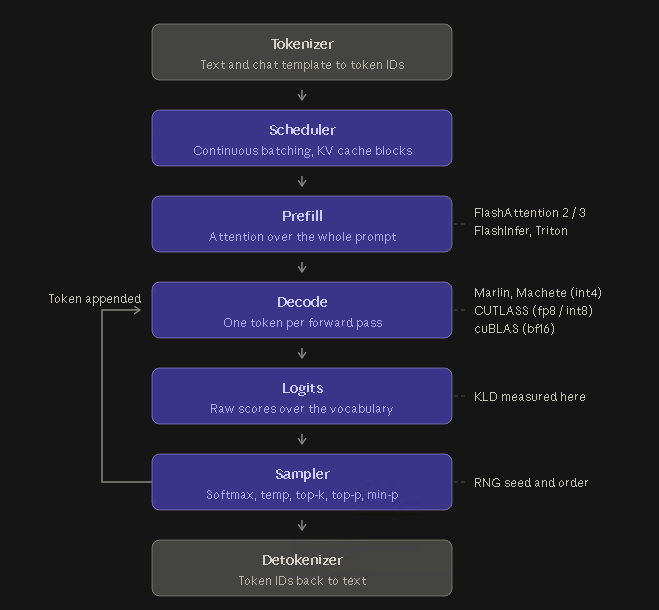
Why your local LLM feels dumber than it is
The same model runs differently on different hardware and software, quietly drifting off-course and even breaking tool calls.
Forums are full of people raving 'this model is amazing,' and then you download it and think 'that's it?' Often the model is fine — the local build just isn't the same thing the lab ran.
Same weights, different GPU, different software stack, different CUDA kernels: the next token comes out different. The author calls it 'implementation divergence.'
1. Swap the attention kernel, break the toolbox
Testing Qwen3.6-27B, the author changed only one thing — the vLLM attention backend, from FlashAttention 2 to Flash Inference. Same GPU, same everything else. Result: a Cisco command that should target `GigabitEthernet0/0/1.201` instead targets `GigabitEthernet0/1/4`, and from there it goes downhill — a `show mac address-table` request becomes a `show run`. One kernel change, and tool calling falls apart.
2. Shrink the KV cache, lose long-term memory
Dropping the KV cache from BF16 to INT8 is recoverable; drop it to INT4 and past 40k tokens tool calls break down. The longer the context, the more errors pile up, and the dumber the model gets.
3. Quantization saves VRAM, but costs IQ
Comparing the official BF16, FP8, INT8, NVFP4, and AWQ quantized variants, NVIDIA's NVFP4 comes in last — by 88k context, half of its next-token choices have changed. Both NVFP4 and AWQ mangled a Cisco command, running `show run` instead of `show arp`, while INT8 and FP8 got it right.
Bottom line: the gap between your local model and the lab's is on both hardware and software. Check whose implementation you're running before trusting any benchmark.

Uncharted Territories, the TV Series
The author believes the key to positive sci-fi is moving the conflict from technology itself to conservative institutions, showcasing technology's benefits.
A writer who has produced hundreds of essays on future tech decided to try his hand at a sci-fi script for XPrize's Future Vision competition, hoping to win $2.5M in production funding. His past work was analytical, but he believes fiction can move people more effectively.
1. Make Tech the Good Guy, Not the Villain
The author points out that traditional sci-fi often makes technology the problem. But flip it around: if tech is great, where does conflict come from? The answer is the old institutions and fearful mindsets that restrict technological development. New tech's downsides are obvious (accidents, job loss), while benefits are hard to foresee, so institutions tend to be conservative. The author wants to turn this fight into a story.
2. Choosing Socotra as the Free Land
The author set his 'free zone' on Yemen's Socotra island. It's underdeveloped but has huge potential: it sits near busy shipping lanes, and solar power plus desalination could solve water and port issues. He thinks future tech could turn it into a tech special zone, like Hong Kong or Singapore in the past.
3. Using AI to Find Plot Holes
Writing a three-season series in five weeks was brutal. The author used a 'gardener' approach, developing each character individually, but inevitably created inconsistencies. AI came in handy: it was excellent at spotting plot holes and character arc failures, but its solution suggestions were often cliché. The author believes AI needs to evolve before it can truly craft compelling stories.

Scrap (2006)
In Pittsburgh, scrapping is not scavenging but a high-stakes metal hunt so competitive that bathtubs and furnaces vanish overnight, and moving them is a dangerous dance.
The author moved from the West Coast to Pittsburgh dreaming of winter, only to find a house with no heat and pipes so cold they could not even apply thread sealant. Then the cast-iron bathtub in the backyard disappeared overnight.
It turned out Pittsburgh is not San Francisco: no one is hunting for kitchy mugs, but for raw metal. Professional scrappers operate here, and they take anything metallic.
1. The Disappearing Tub
The first bathtub vanished within 24 hours, which puzzled the author. Later he learned that scrappers work the alleys for steel and iron, not for treasures. A dumpster full of moldy carpet attracted them too.
The second tub, broken and rusted, was put out as bait. The next day, a pickup truck with two guys pulled up and hauled it away, along with ductwork from the dumpster.
2. The Yelling Duo's Moving Day
Ron and Wade, one bulky and one scrappy, both hard of hearing, communicated by shouting. They agreed to take an old furnace from the basement. But the stairwell was too narrow, and when the furnace jammed, Wade panicked, claustrophobic.
Author told Wade to climb over the furnace, then pushed him through a gap. Ron returned with an axe and chopped the offending pipe, freeing the furnace.
3. The Price of Scrap
When the author asked how much steel is worth, the answer was four cents a pound. It is hard work for little money, but it is life in Pittsburgh.

倒霉的清华紫光
Tsinghua Unigroup went bankrupt due to reckless expansion, but its incubated company YMTC is now highly profitable and about to list, potentially reaching a trillion-yuan valuation.
Recently, YMTC, China's largest NAND memory maker, filed for listing on the STAR Market. In Q1 this year, revenue hit 47 billion yuan, net profit 33.4 billion, more than double the full-year 2025 profit. It ranks sixth globally by NAND revenue.
In 2016, Tsinghua Unigroup and the government jointly founded YMTC. Unigroup was once a top university-affiliated enterprise; the author interned there in 1998-99 developing banking software. But it expanded too fast and went bankrupt in 2022. Tsinghua Holdings exited, YMTC was spun off, Hubei Sci-Tech Investment took over. That year, chairman Zhao Weiguo was taken away; in 2025 he received a death sentence.
Now YMTC's main shareholders are Hubei SASAC, Wuhan SASAC, Donghu High-Tech Zone, and Big Fund I & II. After listing, its valuation could exceed one trillion yuan. Had Tsinghua Unigroup survived, just YMTC alone might rank among A-share top values. Tsinghua fell, Wuhan feasted?