TL;DR
Gondwana only qualifies as a supercontinent because fragments buried under Asian mountains take it from 64% to 80% of the continental landmass — and it was the ring of volcanoes that formed once it assembled that turned Earth from an icehouse into a greenhouse and set off the explosion of life.
Geologists have been arguing for about two decades over whether Gondwana really counts as a supercontinent. A new paper the author co-wrote now settles the question, and squares the account of the explosion of life 550 million years ago while it is at it.
One piece of the puzzle was blocking the title
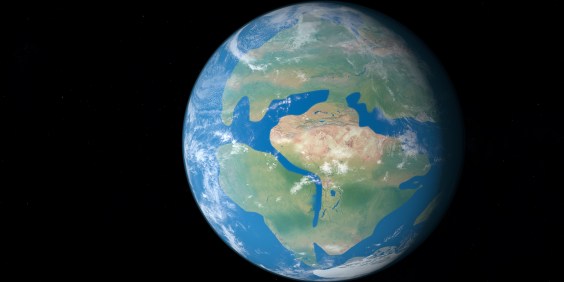
In 1885 the Austrian geologist Eduard Suess found a distinctive plant fossil in the Gondwana province of India, and the same species later turned up in Australia, Africa, Antarctica and South America — those landmasses were once joined.
That landmass is Gondwana, the great southern continent of 550 to 500 million years ago. But in the 1980s came a hard threshold: a continent had to cover 75% of the global land area to be called a supercontinent, and Gondwana measured only 64%.
The author's team was actually studying how granite relates to mineral deposits, and built a global map of the radioactive isotope ages of rocks drawn from deep in the crust. It showed that most of the mountains running from the Himalayas through China into Kazakhstan sit on old Gondwanan fragments.
That brings Gondwana up to roughly 80%. It really was a supercontinent.
The day it assembled, it defrosted the planet
As Gondwana's pieces crashed together, mountain ranges piled up across the landmass. Once they had amalgamated, plate tectonics had to rearrange itself, and a volcanic arc formed around the supercontinent's edge.
That arc ran from Russia through China, Australia, Antarctica and South Africa to the Andes in South America, about 35,000 kilometres long — the forerunner of today's Ring of Fire.
The volcanoes poured out gas, mostly water vapour and carbon dioxide. Today's volcanoes emit a similar amount each day, but this ancient ring erupted continuously for 50 million years, turning Earth from an icehouse into a greenhouse. Life spread across the planet for the first time.
Curated from high-quality sources, with concise summaries and key takeaways.

