TL;DR
The little red dots Webb keeps finding may be objects never seen before — giant stars powered from within by a black hole rather than ordinary black holes — and the two camps of astronomers cannot yet settle the argument.
The Webb telescope stares at faint light from the universe's first billion years and keeps catching something odd: tiny, red, one pixel across, yet as bright as an entire galaxy. A couple turn up in almost every image.
In 2023 astronomers named them little red dots.
First 'universe breakers', then black holes
At first people assumed they were distant galaxies. But a galaxy that bright would have to be absurdly large, and the universe had barely any time to grow one — so they were dubbed 'universe breakers', as if they were tearing up the standard cosmic timetable.
Then detailed colour breakdowns, known as spectra, showed the hydrogen colours smeared into a broad band. That is the signature of gas whipping around a black hole at enormous speed. The mainstream view shifted: little red dots are the supermassive black holes of the early universe.
Spring 2025: the two reddest dots
Two dots were freakishly red. Almost no light at the blue end, then a sudden jump at one particular red shade. This cliff, called a Balmer break, normally appears over a hot ball of hydrogen — a stellar surface.
But a star cannot be that bright, and a black hole does not produce that smooth red hump. Two teams independently concluded they were looking at something new: a black hole star.
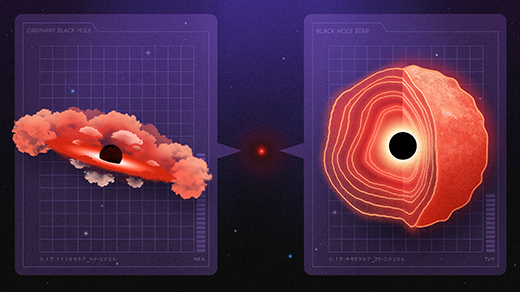
Outside, a vast shell of hydrogen, reaching a dozen times further out than Pluto's orbit. Inside, a black hole acting as the engine, the way fusion powers our sun. The shell would also block X-rays, explaining why other red dots neither flicker nor glow in X-rays.
The other camp: ordinary black holes will do
Roberto Maiolino at Cambridge rebuts each point. No flicker? Early black holes may have eaten more steadily. No X-rays? The thick doughnut of gas and dust around a normal black hole blocks most of them anyway.
He also argues the redness depends on the viewing angle: the reddest dots are simply the ones we see edge-on, their doughnut in the way. He and a collaborator invoke Occam's razor — if black holes explain it, why invent a new species?
By 2026 both theories still fit what Webb has seen. Anna-Christina Eilers at MIT says the field has become thoroughly polarised.
A ghost from 2006 comes back
Mitchell Begelman at the University of Colorado was lecturing on little red dots when he recognised an old idea of his own: the quasi-star, proposed in 2006. A huge gas cloud collapses at the centre straight into a black hole, with the rest of the cloud wrapped around it. In 2026 a team found the model fits the spectra of those two red dots even better than the first version did.
One more clue favours the camp: if little red dots are the infancy of black hole stars, they should grow rarer over time. An August 2026 census found exactly that — by the time the universe reached two or three billion years old, the dots had mostly vanished.
Others suspect both sides are right.
In one line: the young universe may really have raised giant stars with black holes in their bellies — or old black holes may simply be showing us their bad side. Either way, the argument is still going.
Curated from high-quality sources, with concise summaries and key takeaways.

