TL;DR
The line between quantum and classical is not drawn by a conscious observer but by quantum information leaking into the environment and spreading beyond any hope of recovery.
An electron really does go through both slits at once. That has been tested. A table, or the moon, never appears in two places at once. So where exactly is the line drawn?
A cat and a skier
Schrodinger's cat is theoretically both dead and alive. The physicist Jonathan Halliwell says he would rather not talk about the cat: the phrase dates from a time when nobody thought about that sort of thing, and you could not introduce it today.
He prefers another image. A book on quantum paradoxes has a cover showing a man skiing through a snowy forest, leaving parallel tracks — he looks back and sees his own tracks pass on both sides of a tree. No skier can do that. An electron does.
So his answer is blunt: matter is always a wave, sometimes compressed around a single point. The idea that it is 'sometimes a particle' is just a wave squeezed tight.
How the wave goes quiet
The ocean looks flat from a plane and is all waves up close. Quantum effects are the same: up close everything checks out, but zoom out to everyday scale and they get smoothed away.
The bigger factor is collisions. A pollen grain gets hammered by the molecules around it, jitters as Brownian motion, and settles down looking like an honest classical object. Stray photons, gas molecules and faint electromagnetic fields are constantly striking quantum systems and smearing out the interference fringes.
This is decoherence. The quantum-ness has not vanished; it has leaked away into the whole environment, spread so thin you can never gather it back. Like a spoonful of sugar in the sea: still there, but not retrievable.
The moon stays whether you look or not
Einstein's remark that the moon is there even when he is not looking is often told as though consciousness decides reality. Halliwell calls that a misunderstanding: anything mindless will do, a room full of molecules is enough. No human brain required.
He also describes the 'decoherent histories' approach. The universe as a whole has no observer outside it, so all we can work with are today's records — the cosmic microwave background, the plates in a detector — and reconstruct the past from them.
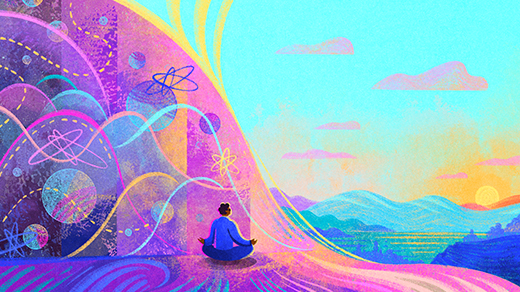
What is striking is that he practises yoga and meditation. He says he is now happier to sit with the mystery than to announce an answer. Instead of asking what the universe is, he asks: what is my relation to all of it?
Curated from high-quality sources, with concise summaries and key takeaways.

