China is building two low-Earth-orbit satellite constellations at once, and what is holding both back is not satellites but the rockets needed to launch them.
Beijing sees Starlink as two things at once: a commercial company and a national security asset for the United States. So China built two answers of its own.
One is for the state, one is for show
Guowang belongs to the Chinese state, the military included. It is run by China SatNet, a state-owned enterprise based in Xiong'an, tightly bound to defence contractors and state telecoms giants.
It is not only about broadband. Public descriptions say it can carry laser communication, synthetic aperture radar and optical remote sensing payloads. Its 2020 filing with the ITU covered 12,992 satellites, some at altitudes of 500 to 600 km.
Its early progress was glacial. By the start of 2024 it had launched just 15 test satellites, while Starlink launched almost 2,000 in 2023 alone.
Its leaders were sexagenarian Party cadres who had spent careers in plodding aerospace state enterprises, and in 2023 the company was named as a target of investigation. A one-company monopoly meant three years of nothing.
Shanghai's project finally gets the green light
In October 2023 the Ministry of Industry and Information Technology ended Guowang's monopoly and let non-state firms in. By then Qianfan had been waiting in the shadows.
It grew out of a Sino-German joint venture that ended in lawsuits. After losing access to that spectrum, the Chinese side quietly refiled, raised 6.7bn yuan in February 2024 and launched its first satellite that August.
By February 2025 Qianfan had 76 working satellites, while Guowang had crept to 38. Qianfan's key difference is transparency: precisely because so much is public, analysts can say it is not a military system.
That lets it work with foreign telecoms firms. Its terminals offer download speeds up to 450 Mbps, it has a memorandum with Airbus, and Brazil will be the first overseas market at scale.
The rocket problem
The two projects spur each other on, which is exactly what Beijing wanted. Guowang brought in leadership a decade younger and now has 238 working satellites; Qianfan has 217, of which 151 launched since April.
But far too little is actually flying. China can launch perhaps 500 satellites a year, while each constellation aims for more than ten thousand, an order of magnitude short.
Qianfan launched nothing for six months in 2025: rules require three bidders per tender, and two public tenders were cancelled because only two entities bid, both subsidiaries of the same state enterprise.
Even what reaches orbit carries little capacity. Qianfan's total usable bandwidth over Brazil is estimated at around 200 Gbps, against Starlink's 13 Tbps there, roughly 65 times more.
ITU rules add pressure: miss launch milestones and a constellation loses its spectrum and orbital slots. Guowang must reach 1,299 satellites, ten percent of its plan, by September 2029, and is far behind.
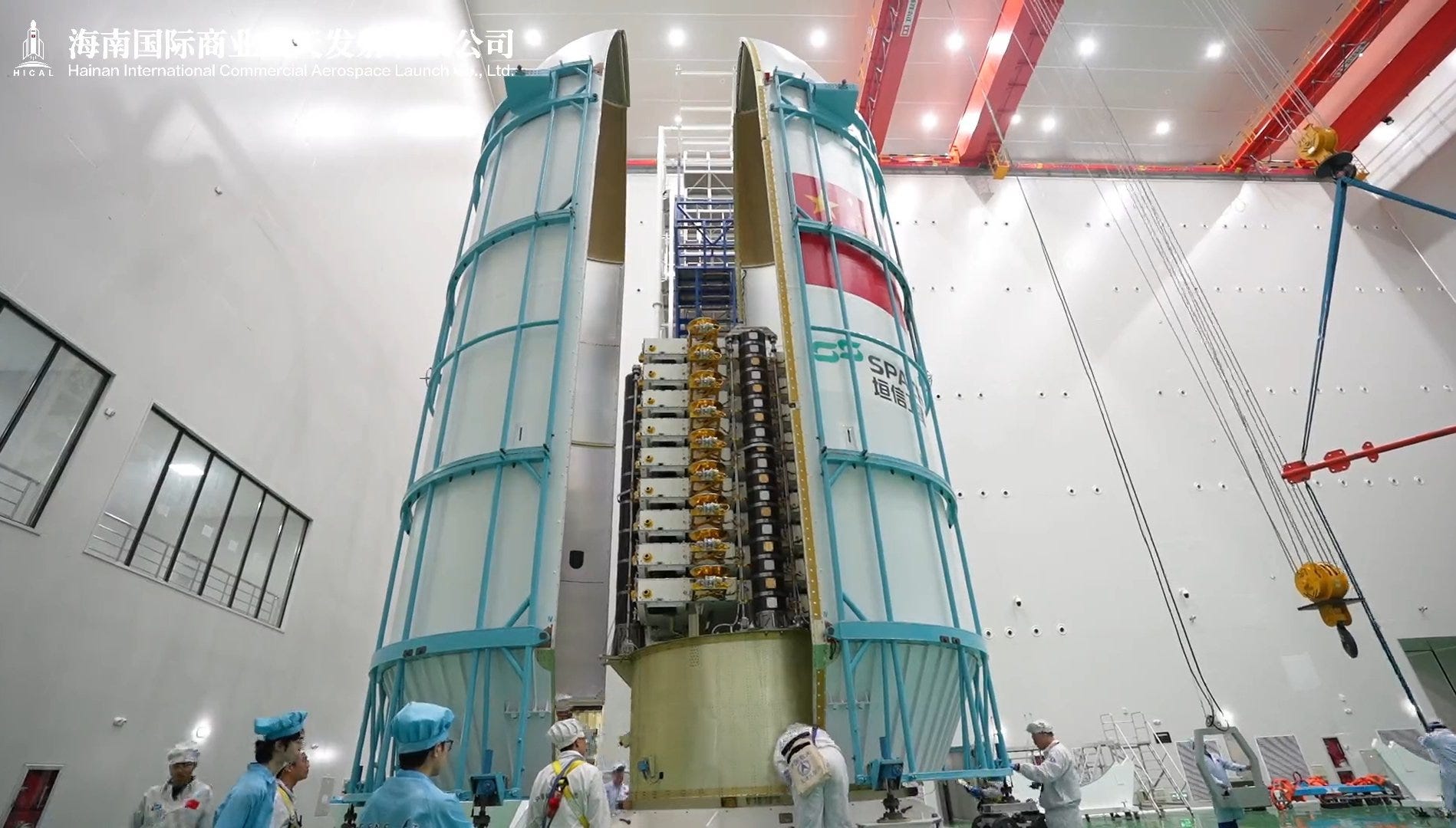
The good news is that commercial rocket firms finally have firm orders. LandSpace launched successfully on 15 September, carrying ten Qianfan satellites at once.
Why it matters
The scarce resource in low Earth orbit is not technology but spectrum and slots, handed out by the ITU against launch progress. China can build the satellites; if its rockets cannot keep up, what it loses is non-renewable real estate in space.


Curated from high-quality sources, with concise summaries and key takeaways.

