California's governor signed a batch of laws barring employers from using AI to discipline or fire workers without human review, to surveil bathrooms, or to infer employees' emotions, and requiring licensed clinicians to make clinical decisions.
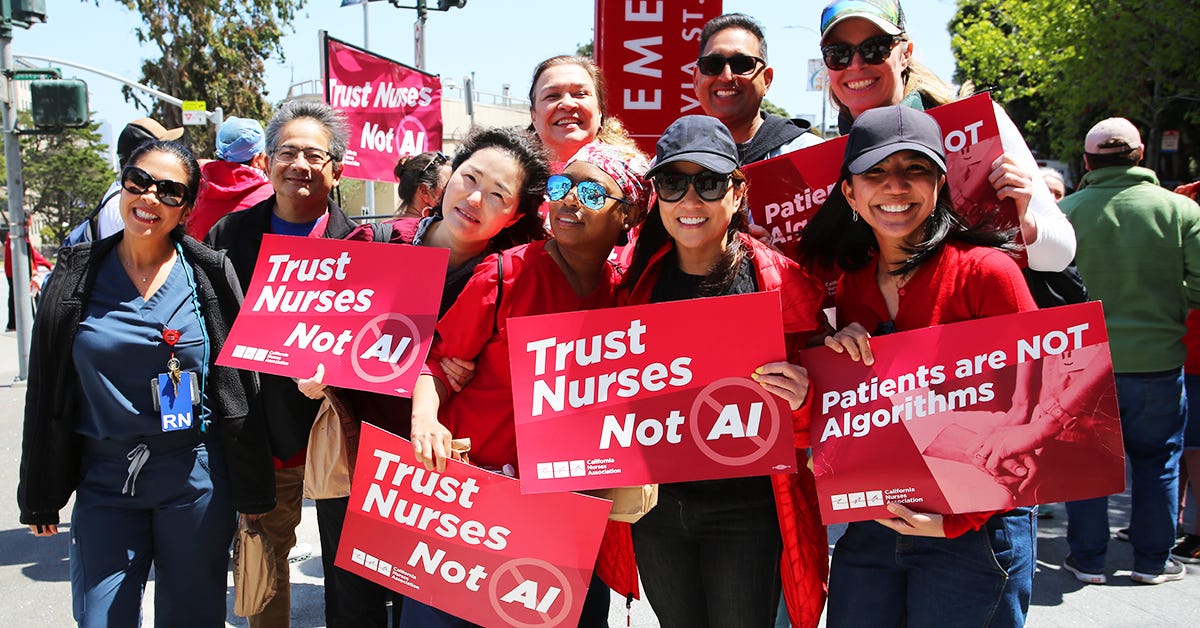
These laws took effect in California at once: a boss cannot dock your pay or fire you on an algorithm's say-so; AI surveillance is banned in workplace bathrooms; AI cannot guess whether you are anxious or resentful; and in a hospital the decision-maker must be a licensed clinician, not a model.
Why it counts as the first stake in the ground
Until now there were essentially no rules on how employers use electronic monitoring and algorithmic management. Lorena Gonzalez of the California Federation of Labor Unions said the unions, the Teamsters and the nurses' association had driven the first big stake into that open ground.
It was not cheap. Tech lobbying groups spent at a scale they had never brought to state-level legislative fights before. Last year Newsom vetoed an earlier version of the no-AI-bosses bill; this year it passed.
The same pen struck two down
Newsom also vetoed a bill protecting nurses who report unsafe AI use, and one requiring public employers to give unions 45 days' notice before buying AI that affects their workers. His journalism bill gives a $20,000 tax credit per full-time local reporter — and the credit disappears if a robot replaces that reporter.
Why it matters
Algorithmic management is becoming the default before anyone votes on it: scheduling, evaluation, discipline and firing increasingly start with a model. California has now written 'a human must review this' into the process, which gives workers elsewhere their first concrete template — and its fate decides whether they get one at all.


Curated from high-quality sources, with concise summaries and key takeaways.

