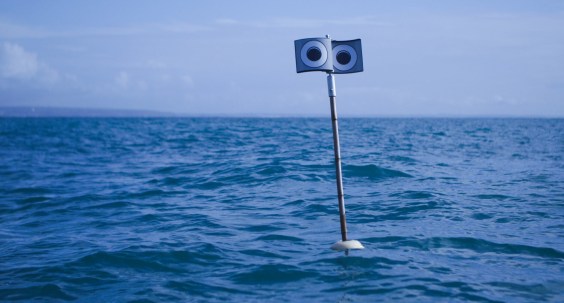
British ecologists strapped a pair of giant cartoon eyes to a buoy and found it cut seabird drownings in gillnets more than a purpose-built bird-scaring kite, because predators are wired to fear being watched.
In 1980s India, Bengal tigers in a nature reserve kept attacking fishermen and woodcutters from behind. Someone remembered the fake eyespots insects evolved to scare off predators and tied a rubber face to the back of the workers' heads. The tigers only came from behind, and a pair of eyes staring at them might put them off. The trick, remarkably, worked for a while.
Ninety-five thousand birds a year
Every year 95,000 diving seabirds drown in gillnets off the coast of Europe. The nets hang vertically and snag fish by the gills, which is irresistible to hungry auks — they dive in, get tangled and drown. The industry calls this 'bycatch', and it gets worse in winter, when fisheries shrink the mesh.
One kite, one buoy
Researchers at the University of Exeter tested two deterrents over two years off Cornwall. One was a bird-scaring kite sold to farmers: bycatch plunged along its path, but only within about a hundred feet of it. The other was the team's own low-tech build, a buoy carrying a pair of giant cartoon eyes, which covered far more water and saved more birds overall.
Once again, the eyes have it.
Why it matters
The whole intervention costs one painted pair of eyes and a buoy, and it stands between tens of thousands of seabirds and drowning each year. The hard part is not the technology but getting fishermen to add one more thing at the net — conservation often turns on small costs nobody wants to pay.

Curated from high-quality sources, with concise summaries and key takeaways.

