
Daily Takes
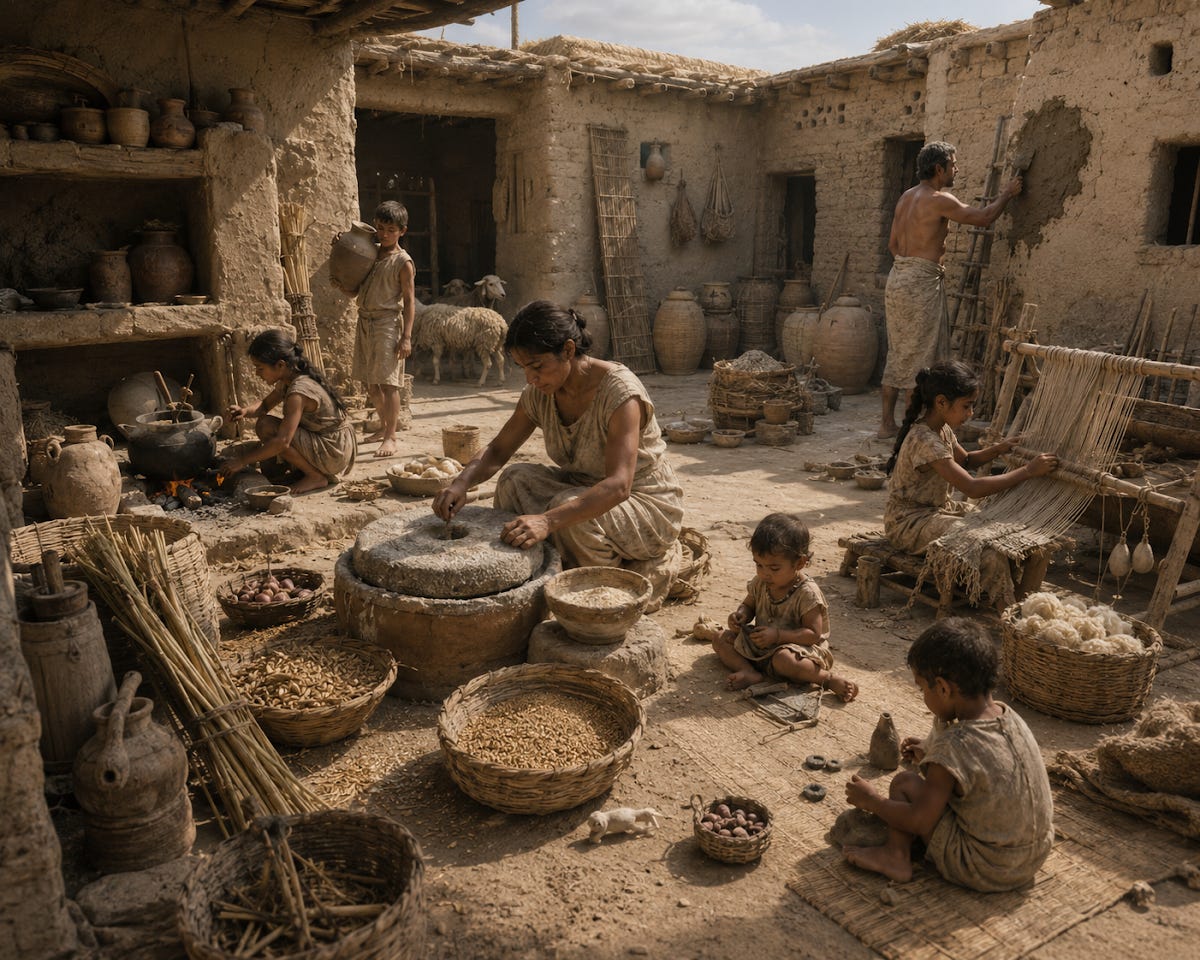
How Households Drive History
What truly shapes history is not emperors, generals, and wars, but the daily needs of countless ordinary families striving to put food on the table.
Textbooks always put emperors, generals, and wars in the spotlight, but if you pull the camera closer, you'll discover that the ones who truly hold the entire production together and drive the plot forward are actually the everyday lives of countless ordinary households.
Let's rewind to the ancient Middle East 4,000 years ago and see how an ordinary family 'leveraged history':
1. Filling their stomachs was the ultimate KPI
In ancient Mesopotamia, the most important task for a family was to grow barley. Two great rivers provided irrigation and fertile land, and more grain meant more people could be fed.
In ancient times, population equaled labor, labor equaled military strength, and military strength equaled national power. Wherever families had more children and enough food, that region could grow into a superpower.
2. When one family can't manage it all, the 'state' is born!
Some major undertakings simply couldn't be accomplished by a single individual or one family alone:
Building irrigation works: to water farmland and guard against floods, thousands of households had to dig canals together. This required someone to organize, direct, and even compel people to work—thus, the earliest states and governments were 'forced' into existence.
Chipping in for big-ticket items: items like oxen and iron plows were 'heavy equipment' too expensive for ordinary families to purchase alone, so they pooled money to buy them collectively and took turns using them.
3. Shopping sprees led to 'civilization'
No household could produce everything it needed. Beyond self-sufficiency, they had to go to the market to buy things they couldn't make themselves—pottery, timber, bronze, and even other vegetables.
When millions of families had the need to 'shop till they drop,' trade emerged, cities became bustling, and trade routes expanded. To compete for these scarce resources, nations went to war, and civilizations rose and fell in succession.
In a nutshell: it was not kings and generals who 'created' history, but the needs of countless ordinary families striving to feed themselves and live better lives that step by step propelled human society into the modern era.