TL;DR
Five mathematicians solved a decades-old puzzle in percolation theory with an unexpectedly simple proof of supercritical sharpness.
On the night before Christmas 2025, five mathematicians at ETH Zurich were not celebrating the holiday. They were working through the night on one of the hardest open problems in percolation theory — a puzzle that defied solution for decades.
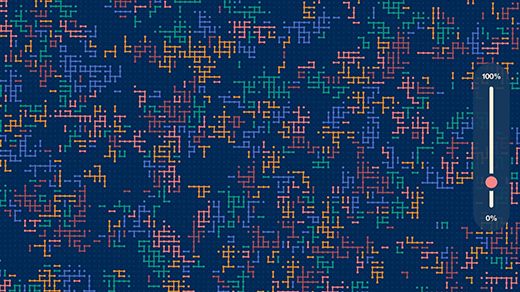
Percolation theory studies how fluid flows through random networks, like water through coffee grounds or a virus through a city. The key is probability: as you gradually open up more 'pipes' in the network, when do puddles suddenly merge into one huge sea?
From coffee to coal: the origins of a field
The inspiration came from coal. In the 1940s, scientist Rosalind Franklin was studying the pore structure of coal, laying the groundwork for later theory. Later, Broadbent and Hammersley turned it into a mathematical game: toss a coin on a grid, heads means connected, tails means blocked.
When the connection probability crosses a critical threshold, the network suddenly develops a giant connected component — a phase transition, like water freezing. But the question was: how fast does this happen above the threshold?
A fortress that wouldn't fall
In 1996, mathematicians Benjamini and Schramm conjectured that 'sharpness' holds on all infinite transitive graphs — highly symmetric networks. But while half was proved in 2007, the other half remained like a fortress.
Schramm died unexpectedly in 2008, leaving the work unfinished. Progress stalled for a decade. Then, in 2025, the Zurich team found a breakthrough, using an improved 'sprinkling' technique to prove supercritical sharpness.
Colleagues called the proof 'stunning' and 'a gem.' It may lead to simpler proofs, but also opens new questions: on 3D lattices, what exactly happens at the critical probability?
Curated from high-quality sources, with concise summaries and key takeaways.

