Computer scientists have made the first major advance in 30 years on the Komlós conjecture, showing that even with huge numbers of objects and attributes, imbalance can be kept almost constant.
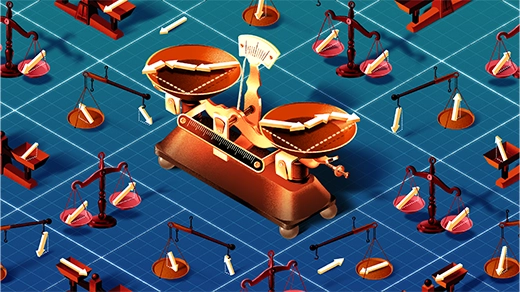
Splitting a group of people with different strengths into two evenly matched teams sounds like everyday trivia, but it's actually a hard math problem.
1. Not just people: cars, drugs, and more
Mathematicians study 'discrepancy' — how uneven a split is, like dividing used cars between two lots or trial participants into treatment and placebo groups.
In the 1980s, mathematician János Komlós conjectured that no matter how many objects or attributes, discrepancy has a universal upper bound. Even he called it 'irresponsible'.
2. Random splits blow up; algorithms tame them
A naive random split makes discrepancy grow with the number of objects N. The best 1998 result capped it at log N.
In 2010, computer scientist Nikhil Bansal devised an algorithmic approach, and by 2025, with Haotian Jiang, he pushed the bound down to the fourth root of log N — for N equal to the number of atoms in the universe, that's only 3.
3. Why it matters
This nearly constant bound is the first improvement in decades, boosting confidence that Komlós was right. The algorithm also has implications for machine learning and optimization.
In short: what seemed impossible is now within reach.


Curated from high-quality sources, with concise summaries and key takeaways.

