Physicists found that the amount of stuff a region of space can hold equals the amount of paint needed to cover its surface, making volume and area the same thing.
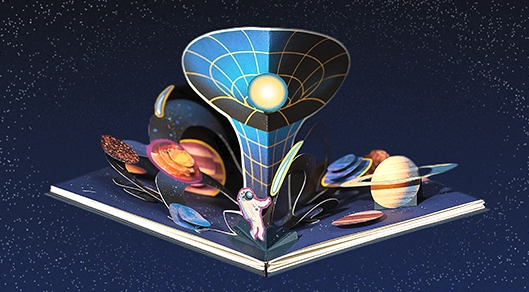
Picture a box you cannot see into. Measure its surface over and over, and you can work out every molecule and every collision inside.
That is the holographic principle: capacity equals surface area. Cubic metres and square metres are set equal.
Why gravity, of all forces
Try the same trick with electromagnetism and it fails. Positive and negative charges cancel out, so the surface looks identical no matter how the charges are arranged inside.
Gravity is different. Mass is always positive, so the warping of space-time at the surface maps onto exactly one arrangement of matter inside.
Black holes gave it away
In the 1970s Bekenstein and Hawking calculated a black hole's entropy, expecting it to grow with volume. It grew with surface area instead.
Since any patch of space becomes a black hole if you pack in enough mass, the room you are sitting in should be holographic too.
Two universes in one snow globe
In the late 1990s physicists built a model: a space that curves inward like a snow globe, rippling with gravity inside, wrapped in a gravity-free quantum surface.
The maths showed the two worlds are the same thing. Like finding that every move in checkers translates into a move in basketball — nobody knows why it works, but it does.
And our universe?
The trouble is that our cosmos expands outward, so it has no surface to project onto.
Optimists counter that an ant deep inside the snow globe cannot detect any curvature, so the two kinds of space may not differ much. And we are the ants.
If holography holds, space is like a game screen: it looks solid, but zoom in and it is pixels flickering on a flat display. Distance is not what separates two things — their independence is what makes them seem far apart.
Physicists admit the question of what is real is beyond their pay grade.
Why it matters
Holography demotes distance from a basic feature of the world to a way of describing it: two things may look far apart only because they do not affect each other. Your commute will not change, but the answer to what counts as fundamental will.


Curated from high-quality sources, with concise summaries and key takeaways.

