New recordings from electrodes implanted in epilepsy patients show that neural activity travels not just as simple back-and-forth planar waves but also as spirals and concentric rings, and that the shape changes with the task a person is doing.
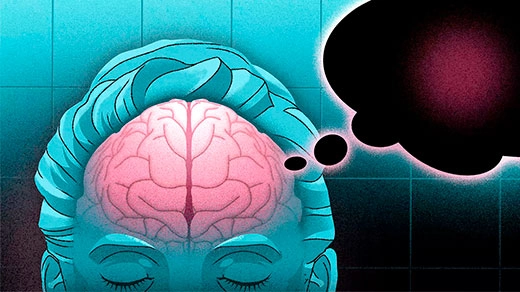
You get out of bed, walk down a dim hallway, wondering what is in the fridge. In a few seconds you have navigated, pulled up a memory and assessed how much energy your body has left. It runs on electricity: about half the brain's energy goes into keeping neurons poised to fire.
Their collective firing moves like a wave around a stadium, one region handing off to the next. Measured from the scalp, or one electrode at a time, it looked like simple up-and-down ripples.
The eye was always there, nobody stood in it
Researchers placed about a hundred electrodes inside the brains of epilepsy patients and recorded while they did memory tasks. Recalling words from a screen produced waves running front to back, as if switching between encoding and recall.
A harder spatial task, navigating a virtual world and remembering where objects were, produced different shapes: concentric rings spreading from a point or converging on one, and spirals turning clockwise or counterclockwise, like a hurricane or a flushing toilet.
Spirals showed up more often in the spatial task. The researchers think they suit more complex memory behavior. It also explains why earlier work saw only flat waves: those may be the outer arms of the storm, recorded by someone missing the eye.
A hundred trillion connections can't beat one turning wave
Rewiring neurons takes days or months, but behavior changes in seconds. Waves move on the same timescale as behavior, which is exactly the gap they could fill.
One researcher likens cortical neurons to Humpty Dumpty on a wall, teetering at the edge of firing. The waves can shift the voltage at synapses, making a neuron more or less likely to fire next.
Not everyone agrees. Gyorgy Buzsaki of NYU argues the waves are just a shadow cast by synaptic activity underneath; the real computation is the current between cells. The debate is open, but the evidence is leaning toward the waves mattering.
Why it matters
If these waves really reorganize the brain in real time, they will eventually become a readable map: the shape of a spiral on an electrode might tell you whether someone is memorizing a route or a word. Brain-computer interfaces and epilepsy surgery would feel it first.


Curated from high-quality sources, with concise summaries and key takeaways.

