Nearly half of the human genome consists of DNA fragments that can move and copy themselves, once dismissed as junk and now recognized as raw material for evolution.
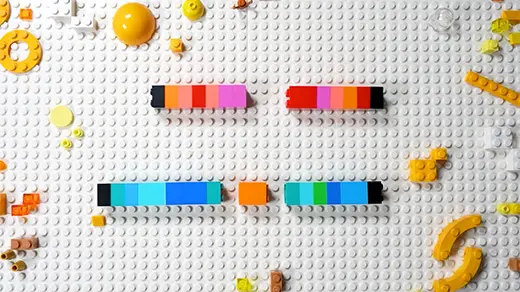
You probably imagine your DNA as a tidy family document, passed down and occasionally edited. In fact, nearly half of your genome is a mob of fragments that relocate and photocopy themselves. Scientists call them transposons, or jumping genes.
A gene that hops, and corn that goes speckled
More than eighty years ago the geneticist Barbara McClintock was studying the colour of corn kernels. On a single cob, some kernels came out solid purple, others yellow with purple speckles. The cause, she found, was a stretch of DNA that could jump out of the chromosome and insert itself into the middle of the purple pigment gene, breaking it. When it jumped away again, the gene recovered and the kernel turned purple.
She published the result in 1944 and her colleagues largely refused to believe it, until she won the Nobel Prize in 1983.
There are two main kinds. One really does use scissors: an enzyme cuts the sequence out of its old spot and pastes it somewhere new. The other is a copier: it transcribes itself into RNA, then reverse-transcribes back into DNA at a fresh site. Because it copies rather than cuts, this second kind floods the genome with itself — close to half of the human genome is this kind of residue.
Some of them look almost exactly like viruses. HIV is the celebrity example: it copies its genes into the genome of the white blood cells it infects and makes the cell do the reproducing. Even when it does not kill its host, it leaves a mark behind, like a splinter lodged in a finger. Those viral ghosts are estimated to make up 8% of the human genome. A good part of you is, literally, virus.
Useful enough to stay
These fragments have a knack for crossing species: they hitch a ride on a passing virus. In the genomes of just 307 vertebrates, researchers have found nearly a thousand such cross-species jumps.
So is it a parasite or good material? The British peppered moth answers that. Two hundred years ago the moth had white wings with black speckles, well camouflaged against pale bark. When the Industrial Revolution blackened the trees with soot, the black-winged moths did better. In 2016, researchers sequenced hundreds of peppered moth genomes and found that nearly every black moth carried a transposon inserted at the start of a gene controlling wing development. The white ones did not.
They dated the insertion to 1819 — just after pollution began changing the environment. The environment shifted, and a random insertion that would normally have been weeded out suddenly became an advantage, so it stuck and got passed on.
From pest to partner
The same mechanism reaches further back: the eyes of animals, the adaptive immune system of jawed vertebrates, and the placenta. Which means that mammals, humans included, owe the ability to carry a pregnancy for months in part to a piece of transposon.
The picture has changed accordingly. It is no longer just parasitic, junk, selfish DNA, but an old partner in coevolution. One geneticist compares the host genome's dependence on it to an addiction.
Most fundamental of all: to keep these hoppers under control, organisms first evolved the ability to switch genes off. Then that machinery was repurposed — and one genome could build dozens of cell types. The tool for silencing transposons became the tool for building a body.
Why it matters
Reclassifying half the genome from junk to asset is more than a textbook correction: it suggests that what looks like noise, redundancy and disorder may be exactly the slack a system needs to respond when the environment changes.

Curated from high-quality sources, with concise summaries and key takeaways.

