Scientists had assumed energy in a turbulent system flows in only one direction, but watching brine shrimp swim revealed that a swimming angle greater than 45 degrees flips the flow entirely.
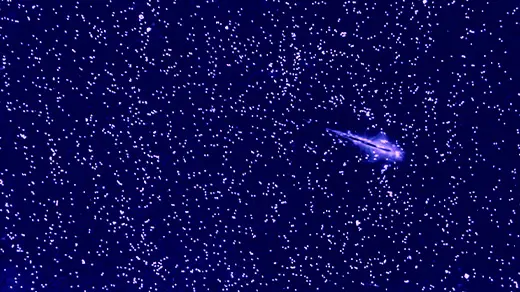
In the 1960s, comic-book ads sold a 'bowlfull of happiness' through the mail: a paper envelope of freeze-dried eggs. Dropped into salt water, they hatch into brine shrimp, the creatures better known as sea monkeys. They are about a centimetre long, swim upside down and beat their legs furiously.
In a lab at the University of Pittsburgh, researchers put these shrimp into salt water expecting to study how living things stir fluids. They found something stranger instead.
Energy was supposed to go one way only
The foam below a waterfall, the bumpiness of a flight, the milk swirling in coffee — that is turbulence. A century ago an English meteorologist summed it up in verse: big whirls have little whirls that feed on their velocity, and little whirls have lesser whirls, and so on to viscosity.
Two-dimensional turbulence is different: energy runs from small scales up to large ones. Jupiter's Great Red Spot works this way, with small vortices around the rim feeding the giant storm at the centre. For decades nobody seriously asked whether that direction was fixed.
45 degrees is the dividing line
The team watched shrimp in a tank and ran the numbers again and again, and kept reaching the same conclusion: the angle between the shrimp's body and the direction of maximum stretching decides which way energy goes.
Below 45 degrees, energy moves from small scales to large ones, exactly as textbooks say. Above 45 degrees, it reverses — drained from the large scale to energise small disturbances.
Swapped for an array of centimetre-long rods, the effect held, and the researchers could steer the flow either way at will. Colleagues in Turin reproduced it in numerical simulations.
Bending it is far cheaper than holding it
Between two fluids sits a 'transport barrier'. Breaking it, by this theory, takes less than 1% of the energy needed to keep it intact. That could matter for controlling pollution or mixing fluids in drug development.
Of course, a shallow lab tank is a long way from the atmosphere. But there is no mathematical reason the effect should not extend. The team is now testing the idea on tabletop tornadoes.
Why it matters
The direction of energy in turbulence turns out not to be a law of nature but a matter of angle — meaning we may one day steer the flow by tilting an obstacle just so, rather than fighting the current head-on.

Curated from high-quality sources, with concise summaries and key takeaways.

