Training the model behind early ChatGPT used 185,000 gallons of water, and a single hyperscale data center can draw up to 5 million gallons a day, competing with residents for drinking water.
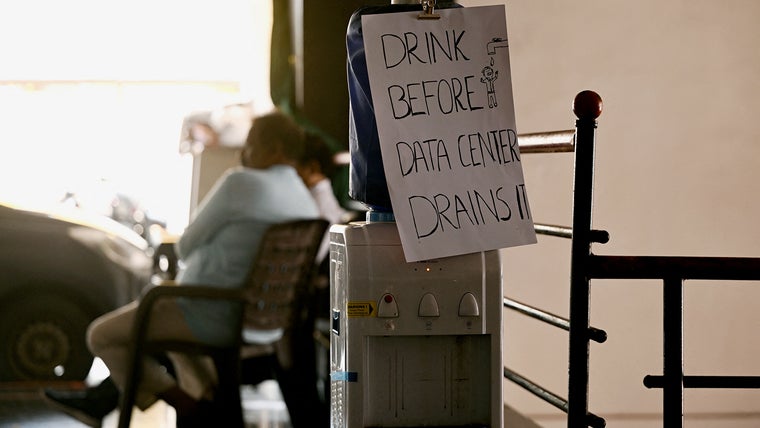
After ChatGPT launched in 2022, tech companies sold it as a universal technology that could replace psychologists, teachers and lawyers. The water bill took longer to surface.
Every chat pours out a bottle
A 2023 paper from the University of California estimated that training the large language model behind the first ChatGPT used 185,000 gallons of water.
Every extra exchange, every email it drafted, effectively poured a bottle of water down the drain.
Google and OpenAI then published their own figures, saying one query used mere drops. Independent researchers were not convinced: the numbers left out the water needed to power and cool the servers.
A hyperscale data center can draw 1 to 5 million gallons a day, as much as a city of 10,000 to 50,000 people.
And it needs clean water. Tapping the public drinking supply is cheaper than treating its own, so data centers end up competing with communities for the same glass.
Chile pushed Google back
Mass protests broke out in Chile in 2019, with water as one of the slogans. Google was then seeking approval for a $200 million data center in Cerrillos, on the edge of Santiago.
It promised jobs and prosperity. A residents' group called MOSACAT went through the paperwork and found short-term construction work but few permanent jobs, and a very large water demand.
By Google's own projections, the facility would use 169 liters every second — in one day, as much water as all 80,000 residents of Cerrillos drink in a year.
It wanted to draw from an aquifer restricted since 2005; weeks before approval, that restriction had been upgraded to a full ban on new extraction.
Chile had been in drought since 2010. By 2021, more than half of its 19 million people lived in areas of severe water scarcity, and hundreds of rural communities relied on tankers.
After months of campaigning, a December 2019 referendum saw 49% reject the project and 38% support it. In February 2022 Google returned with a proposal to cool the center with air conditioning only, not water.
A different country, the same script
In 2022 Microsoft announced a data center in Quilicura, Santiago, the same year strict water rationing took effect. Residents said the company came only to use water and dry up the land, giving nothing back.
Uruguay faced its worst drought in 70 years in 2023, and Montevideo declared a state of emergency. Researcher Daniel Pena had to go to court to obtain Google's water data, which showed a 72-acre site planning to use 2 million gallons a day.
Near Fortaleza in Brazil, at least four major data centers sought to set up, one the size of 12 football fields and costing an estimated $10 billion, developed to serve TikTok. The region was under emergency drought conditions in 16 of the 21 years to 2024.
Why it matters
Tech companies present data centers as considerate neighbours, but water is zero-sum: what a facility draws is what a community no longer has. Chile and Uruguay show that when residents can read the environmental reports and get the data, even the largest company has to change its plans.



Curated from high-quality sources, with concise summaries and key takeaways.

