TL;DR
Even if income affects happiness, the effect is smaller than intuition suggests, but that doesn't mean income is irrelevant.
Can money buy happiness? A recent debate has stirred things up. Author Alexander and critic Pritchard went back and forth over the data on income and well-being.
First, the facts both sides accept: quadrupling your income (say, from $50,000 to $200,000) has about the same effect on daily happiness as a third of the difference between having a headache and not, or between being a full-time caregiver and not.
1. The income effect is small? Depends on the comparison
Pritchard mocks this as negligible. But Alexander counters: you can't just compare point-in-time effects. Rich people have money every day, so the right comparison is a headache every day vs. none. A permanent headache would be awful.
Other anchors: a 4x income difference is about the same as the happiness gap between married and divorced people, or between a weekend and a weekday. Suddenly it doesn't look so trivial.
2. How much can redistribution save?
Pritchard argues that since happiness scales with log(income), taking from the rich and giving to the poor should boost happiness a lot. Alexander runs the numbers: confiscate all US billionaire wealth, invest it, and give the interest to the bottom quintile. Average poor household income rises from $20K to $25–30K, but national happiness rises by only about 0.05 points on a 1–10 scale. Compare that to the 1.2-point effect of a 4x income increase that Pritchard dismissed as trivial.
So redistribution helps, but not much. And without growth, there's nothing to redistribute.
3. Don't cherry-pick countries
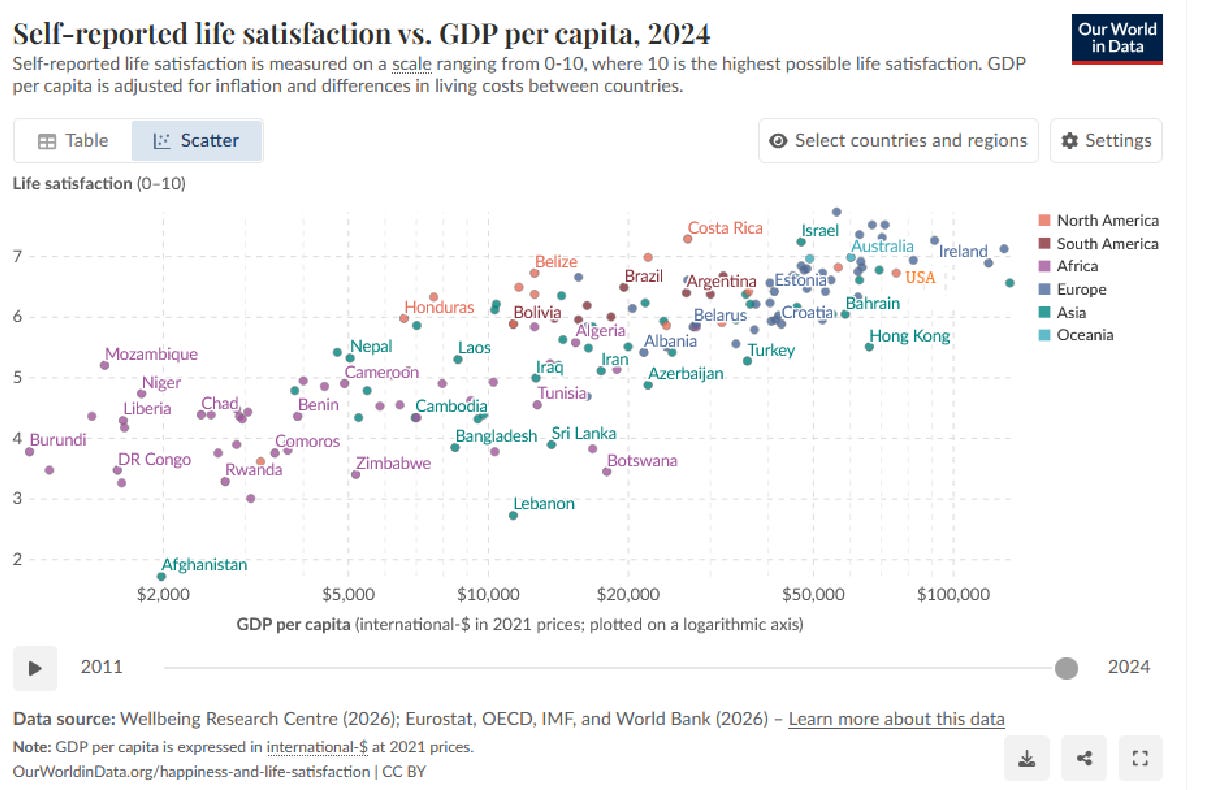
Pritchard compares Botswana and Belize, claiming the latter is 3.27 points happier, equal to a millennium of growth. But Alexander notes the US is already near the top; it can't gain 3 points. Belize's happiness might be due to Latin American temperament, not policy.
In short: income's effect on happiness is real, not enormous, but far from irrelevant. The lesson is to focus on overall growth, not just redistribution.
Curated from high-quality sources, with concise summaries and key takeaways.

