TL;DR
The U.S. Strategic Petroleum Reserve can hold over 700 million barrels of oil, but geological and maintenance constraints mean it is not a bottomless tank, and its actual emergency drawdown capacity is far smaller than advertised.
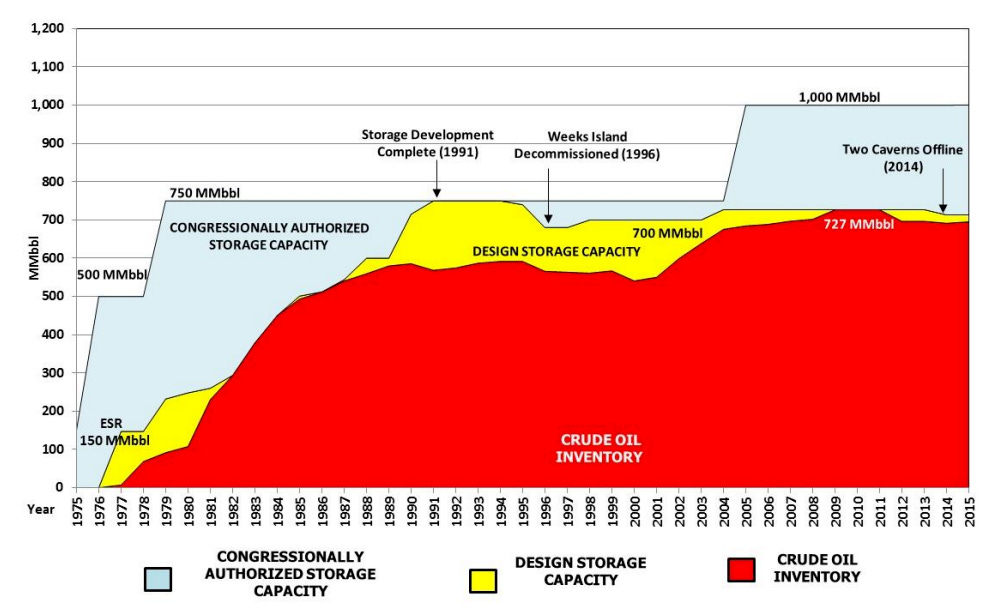
The U.S. Strategic Petroleum Reserve (SPR) is the largest crude oil storage facility in the world, able to hold 714 million barrels—about 10% of the country's annual consumption. It was born out of the 1973 oil embargo, meant to cushion import disruptions and prevent price spikes. Recently, the Trump administration has been drawing down the reserve—roughly 120 million barrels so far—in response to Iran closing the Strait of Hormuz.
A big question is: how much can actually be taken out? Some claim there's a hard safety floor of 300 million barrels, below which the caverns would be damaged. But the author's look into official documents found no clear basis for that figure.
Salt caverns are not steel tanks
The oil sits in underground salt domes along the Gulf Coast. A salt dome is a massive underground salt formation, pushed up by geological forces. Salt is nearly impermeable to oil, so people dissolve it with water to create caverns—a process called "solution mining."
Oil floats on a heavier layer of brine in each cavern. To remove oil, water is pumped in, forcing oil out the top. To refill, oil is pumped in while brine is drawn off. The caverns are always full of liquid; only the oil-brine boundary moves.
Trouble is, salt dissolves and rocks creep. Every 100 barrels of water pumped in dissolves about 15 barrels of salt, so each full drawdown enlarges the cavern. The walls thin over time and eventually can't withstand the pressure, risking leaks. Engineers monitor cavern "life" with sonar; some of the older ones may only have one or two drawdowns left.
Where do the 300-million claims come from?
Experts give wildly different "safe floors": a JPMorgan analyst says 150 million barrels, Rapidan Energy says 170 million, a Texas A&M professor says 250 to 300 million, and a former Biden energy advisor hears that "you can't get near 300 [million]" without damaging the caverns.
None of these claims appear in official reports. The Department of Energy, the GAO, and Sandia National Labs only mention a small amount of "roof oil" needed to protect the cavern ceiling (about 12 million barrels), and the definition of a full drawdown (removing 90%, leaving about 70 million barrels). No document states that going below a certain level causes structural damage.
The author suspects these numbers come from unofficial conversations or conflated concepts. But it also means the reserve's true emergency capacity is more limited than the headlines suggest—the infrastructure is aging, maintenance has been deferred, and even the degasification plant was dismantled years ago.
At the end of the day, the SPR is a big tank that can help you survive the first shock, but it's not a bottomless well.
Curated from high-quality sources, with concise summaries and key takeaways.

