TL;DR
The Raptor engine did not get sleek because SpaceX reinvented it, but because it stripped out all the parts that existed only to debug an experimental engine.
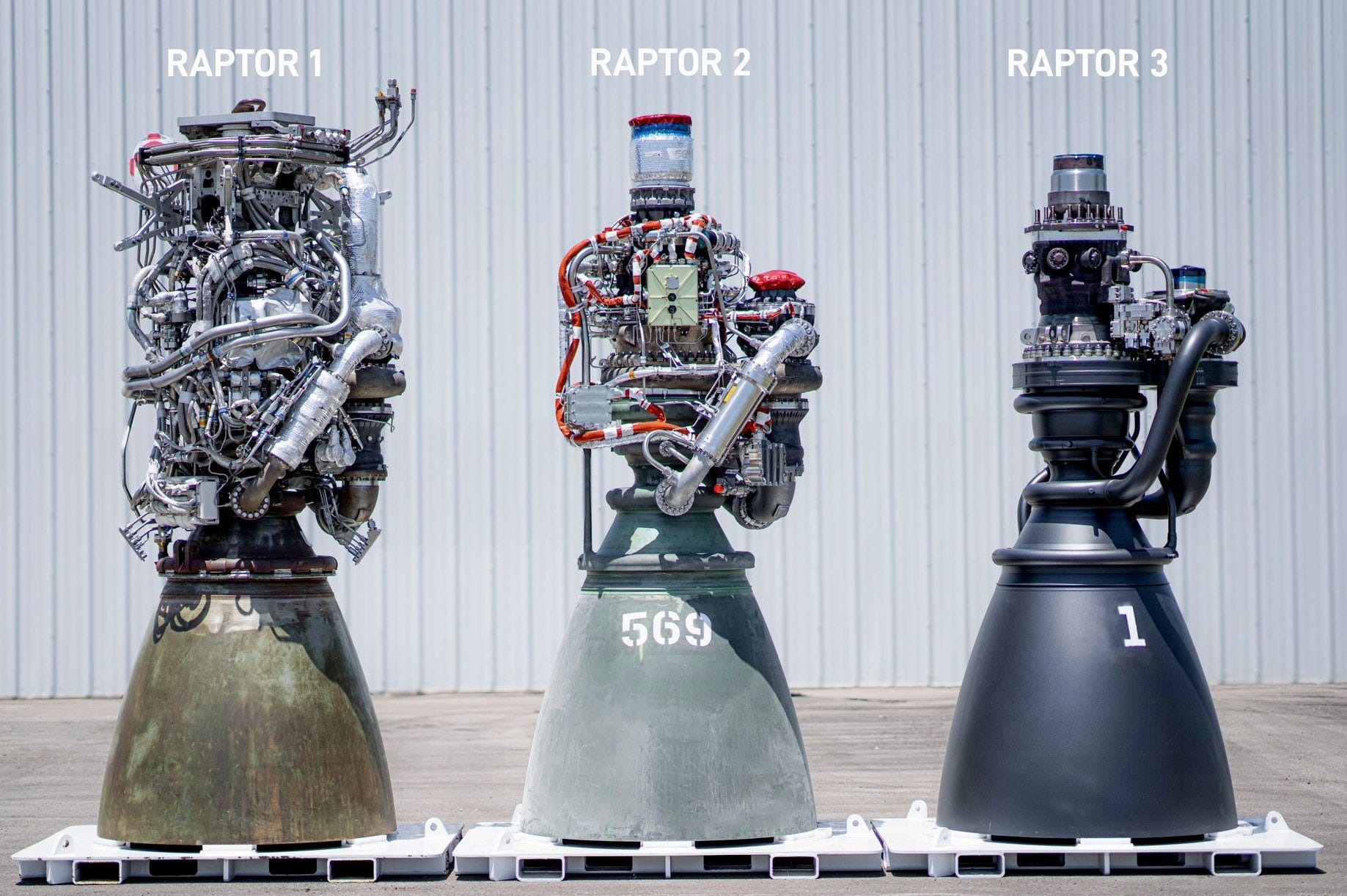
That photo of three generations of SpaceX's Raptor engine sitting side by side? Plenty of people assumed it was fake. On the left, a tangle of pipes and wires. On the right, something that looks like a finished industrial design object. The then-CEO of United Launch Alliance tweeted that there was no need to dress it up by showing a half-assembled engine. SpaceX's president answered with a photo of a Raptor 3 firing successfully.
First, what this thing actually is. A rocket engine works on a crude principle: throw mass backwards, and you get pushed forwards. Throw more, throw it faster, and you get more thrust. A child letting go of a balloon's neck and watching it zip around the room is the same idea.
More power, more trouble
Big thrust means forcing fuel and oxidiser into a combustion chamber and burning them hard. But the pressure in that chamber is high enough to push propellant back up the lines, so pumps have to pressurise the fuel first. Those pumps are monstrous: the one on the Saturn V's F-1 engine drew roughly as much power as a nuclear submarine sends down its propeller shaft.
The usual trick is to burn a little propellant to spin the pump. Raptor uses the fussier option, full-flow staged combustion: two preburners, one burning fuel-rich, one oxidiser-rich, with all the propellant passing through before it reaches the main chamber. Before Raptor, only two such engines had ever been built, and neither flew.
What got deleted was parts, not complexity
The author wanted to know what changed between versions. There are no official schematics and nobody has taken a Raptor apart, so the picture comes from stray Musk replies and fan-made diagrams. The conclusion: the core architecture never changed. Same two pumps, same two preburners. What changed was everything around them.
Version 1 was essentially a test engine, covered in sensors watching temperature and pressure all over the place. Once the engine was dialled in, most of those could go. The main chamber igniters went too - the exhaust coming out of the preburners is hot enough that it hardly needs encouragement.
Bolted flanges became welds, saving weight and leak points at the cost of serviceability. Many of the pipes were not removed but moved inside the engine, made possible by 3D printing. The real prize was scrapping the heavy heat shield and fire suppression system wrapped around the outside.
So the truth behind that comparison photo: the simpler it looks, the more complex it is inside. And it is not sorted yet - Starship's thirteenth test flight in July was stopped by flight software at ignition when several Raptor 3s failed to start.
Curated from high-quality sources, with concise summaries and key takeaways.

