TL;DR
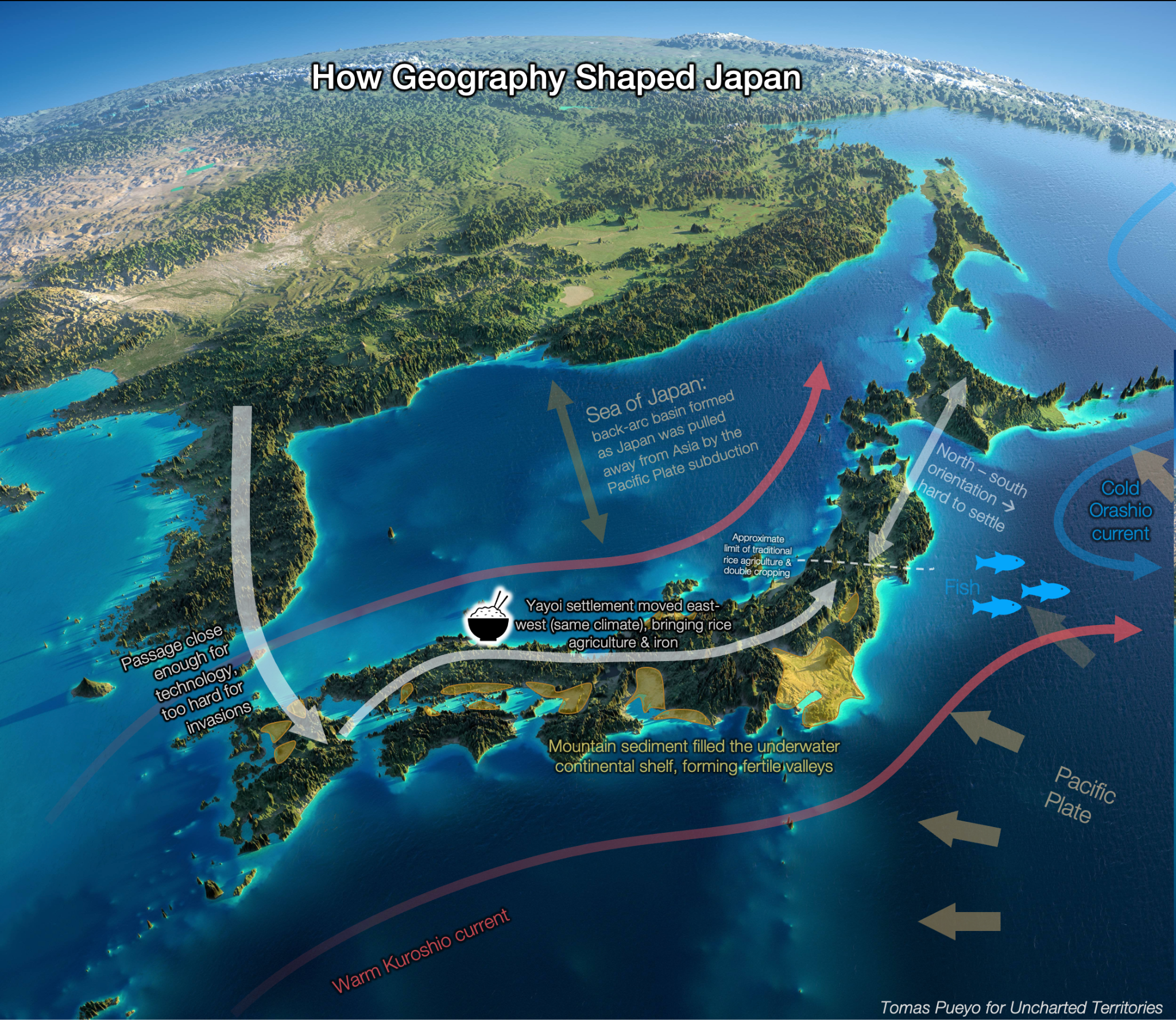
Japan's population sits where it does because of geology: colliding plates built a mountain ridge with fertile valleys, and rice farming could only push so far north.
A mountainous island nation where only twelve percent of the land can be farmed still feeds over a hundred million people. The explanation starts with plates shoving against each other.
The land was squeezed upward
The Pacific plate dives under the Asian plate, pushing up a volcanic ridge. The part above water is Japan; the rest is a long string of small islands offshore.
So Japan is bigger than it looks: three of its four farthest points are remote islands. They give it the world's eighth-largest exclusive economic zone, and they are why the US fought so hard for Iwo Jima and Okinawa in the war.
The same collision dug a gap that filled with seawater, cutting Japan off from the mainland. The shallow water around the islands is old continental shelf, and sediment washed down from the mountains piled up there into the richest valleys.
Between Japan and Korea lies 200 km of sea, five times the gap between France and England, with a warm current making it worse. The Mongols invaded twice and were turned back both times.
Rice could only go so far north
The problem is that only twelve percent of the land is good. But rice is the most land-efficient staple there is. Around 1000 BC, migrants from Korea brought wet-rice farming in, and the population took off.
By around 700 AD the best valleys were used up and growth stalled; by 1200 new techniques such as a second, winter crop restarted it.
Rice had a hard northern limit: warm and cold currents meet in northern Honshu, and beyond that it is too cold to grow. So Hokkaido was never fully absorbed and still carries more indigenous ancestry. Sakhalin, further north, is emptier still.
The cold current from the north is called Oyashio, the parent current, and it carries the nutrients behind Japan's fishing culture. Sushi is the summary of all of it: rice from the south, fish from the north, land and sea stacked on one piece of rice.
Curated from high-quality sources, with concise summaries and key takeaways.

