TL;DR
Heart rate variability and readiness scores are marketed as measures of health, ageing and even lifespan, but no peer-reviewed study links them to health outcomes.
Open any smartwatch and you will find a score: today's recovery, readiness, body battery. Apple just increased its watch's heart rate variability output 24-fold and added a readiness score from 0 to 10. Over a hundred million American adults are wearing one of these.
The band is not measuring that thing
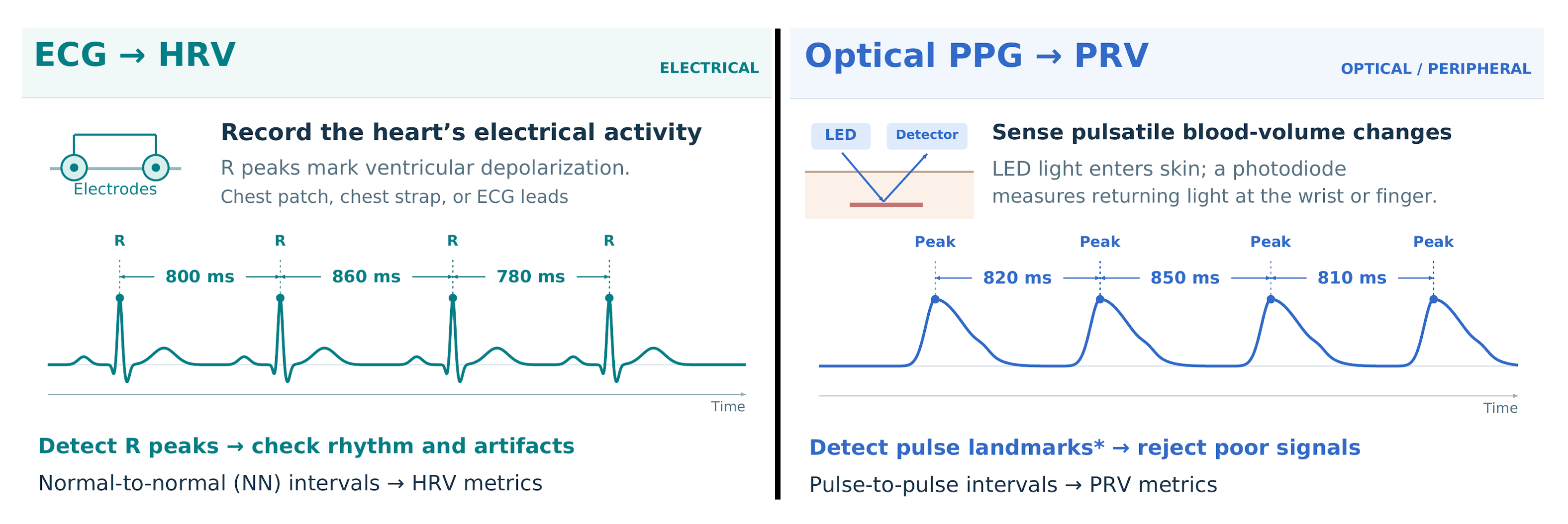
Heart rate variability is the millisecond variation between consecutive heartbeats. Three decades of research do show that people with low variability have higher all-cause and cardiovascular mortality.
But all of that work used electrocardiograms. A wristband uses light shone through skin to measure pulse intervals, with blood vessels and tissue adding a delay in between. The two only agree when the person is completely still.
Four devices, four numbers, one night
The author wore an Oura, an Apple Watch, a Fitbit and a mattress sensor at once. On the same day the curves disagreed in both shape and absolute value. The algorithms differ too: Apple uses SDNN, most others use RMSSD, and nothing is standardised.
The populations studied skew badly, almost entirely healthy adults. One study of over 900 people found that in chronic conditions — cardiovascular, endocrine, neurological — the optical numbers systematically underestimate, and concluded it is 'an invalid surrogate for HRV.'
The score is invented, the algorithm can change overnight
A readiness score is a company folding several metrics into one number, with no published algorithm and no validation against health outcomes. One review found heart rate variability contributes 86% of such scores.
A 90 on an Oura has no relationship to a 90 on a Fitbit. Companies can change the algorithm at any time without telling you. Apple publishes no data on its score, not even on its own website. The one decent study used golfers' recovery scores against their stroke counts — hardly a health outcome.
The only metric shown to be consistently accurate is resting heart rate. The author's advice: if you must look, watch one device's trend over two or three weeks, never a single day.
Low variability does correlate with disease risk, but actively raising it — through breathing exercises or anything else — has no evidence of improving health. A British genetic study even suggests it reflects your physiological state rather than causing outcomes.
In one line: the score on your watch is not lying to you — it is just not yet anything, and you believed it first.
Why it matters
This is not another complaint that wearables are inaccurate. It exposes a complete commercial loop: companies sell devices and subscriptions on the back of an unvalidated score, while users lie awake anxious about a number they cannot verify and that can be rewritten overnight — 'orthosomnia' is already a term in the literature.
Curated from high-quality sources, with concise summaries and key takeaways.

