TL;DR
A Spanish Supreme Court ruling that swimming in did not count as climbing the fence, amplified on social media, was read on the Moroccan side as: once you arrive, you will not be sent back.
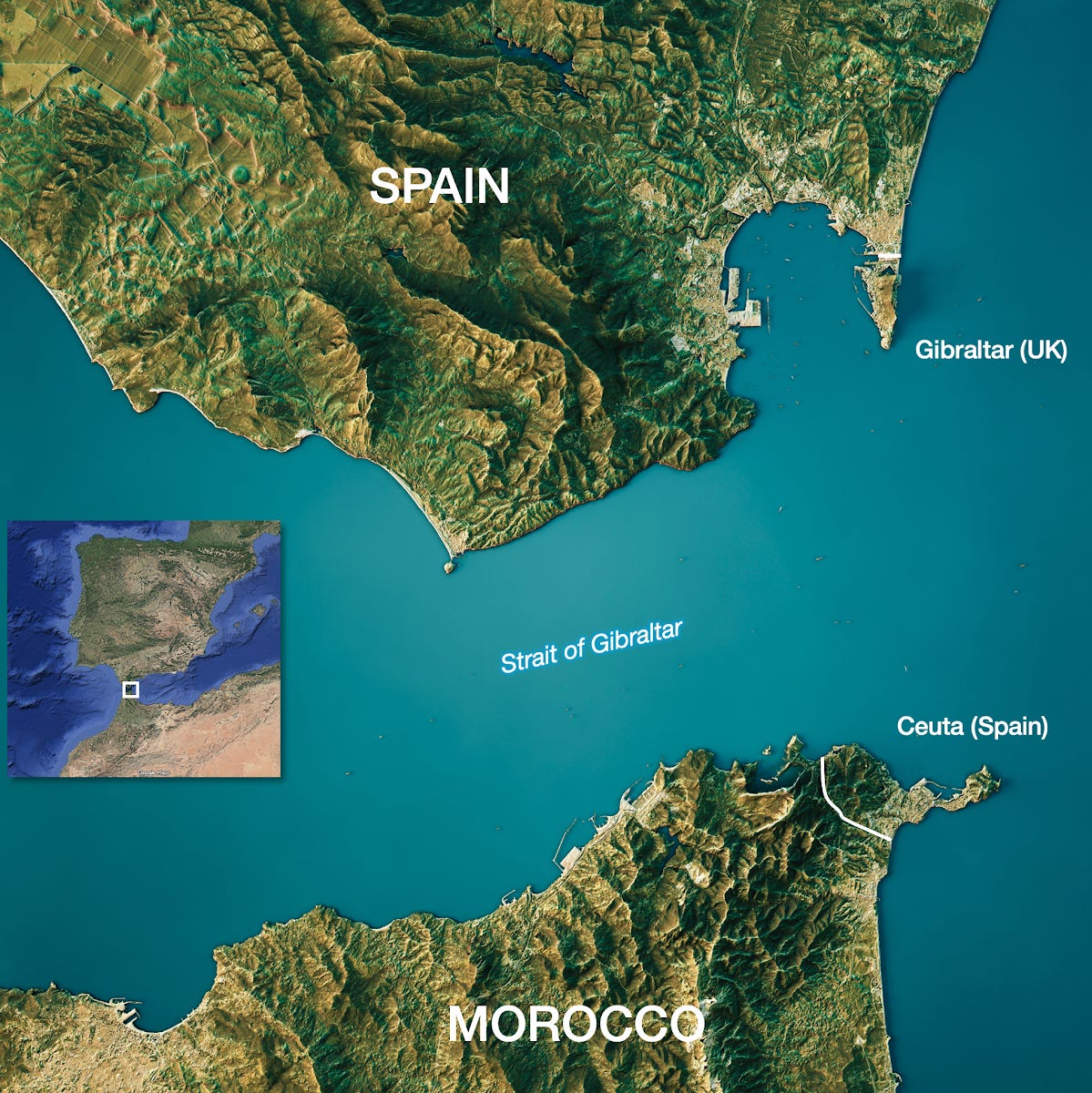
On 30 July 2026, more than 70,000 people crossed from Morocco into Ceuta, a Spanish enclave in North Africa. The city has 84,000 residents.
One ruling turned water into a gate
Spain's practice had been hot returns: catch them, send them straight back to Morocco. Courts kept pushing back, since some of the arrivals might be asylum seekers or minors.
On 29 June 2026, Spain's Supreme Court ruled that hot returns apply only to people who climb the fence. An Algerian had swum over, been returned, and lawyers built a case around him. They won.
On social media the ruling was compressed into a single line: swim to Ceuta and you will not be deported. Most migrants did not know Spanish case law and took it literally.
Trucks, an anchor and police who stepped aside
Trucks appeared to carry people to the border. Several videos show Moroccan police watching the convoys head for the frontier without stopping them.
A presenter on Morocco's state broadcaster shared the message; he is also reported to speak for a Moroccan government body.
Spanish intelligence warned on 29 July that some 180,000 people were preparing to cross. Within 24 hours, 60,000 to 80,000 came through. Around 100 died, mostly by drowning or being trampled.
A Spanish police union accused Morocco's government of involvement. Spain's Guardia Civil says it identified Moroccan intelligence officers among the migrants.
This has happened before
In 1975, Morocco sent 350,000 civilians across the border to force Spain to give up Western Sahara. It was called the Green March.
In 2021, after Spain took in a Western Sahara independence leader for medical treatment, Morocco loosened border controls and about 8,000 people entered Ceuta. A year later, Spain's prime minister shifted Spain's position on Western Sahara from backing self-determination to backing Moroccan rule.
Ceuta lets Spain control the shipping lanes of the Strait of Gibraltar. Spain has held it for over 400 years, longer than Morocco has existed as a country. Morocco rarely says it outright, but a minister has called for talks on 'the future of Ceuta and Melilla'.
The author is not sure Morocco orchestrated it, and leans toward it having let things run.
Who actually pays
Supermarkets were looted, camps went up wherever people could pitch. There were reports of gang rape of underage girls, daily sexual assaults, robberies, brawls, burned cars.
Most people eventually went back to Morocco. About 5,000 remain, nearly half of them minors whom Spanish law cannot deport immediately. The government wants to send 500 of them to the mainland, away from their families.
Spain's response is to extend the fence 500 metres into the sea, so that people who swim can be counted as people who climbed the fence.
The rest are still on the streets, and residents are demonstrating, sometimes through the night.
Why it matters
The mechanism here was not migration but a court ruling plus a share: a legal sentence stripped of its context became, within hours, the operating instruction for tens of thousands of people. Borders now depend not only on how high the wire is but on how fast a rumour travels; Spain's answer was to move the fence into the sea and change the definition, not the gate.
Curated from high-quality sources, with concise summaries and key takeaways.

