A 1926 silent film cut the narrator, invented an evil brother named Derek for Captain Ahab, and turned an unread novel into the Great American Novel.
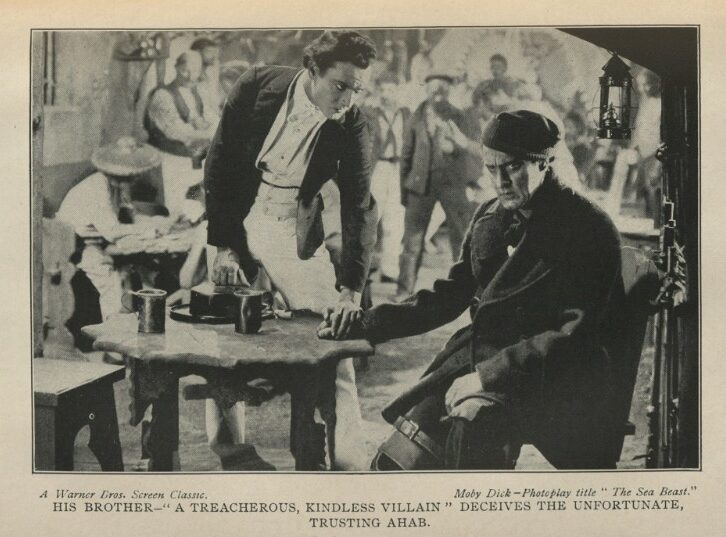
In 1926 Warner Bros. released The Sea Beast, the first film adaptation of Moby-Dick. It opens on a leather-bound copy of the novel turning to page one, but the line 'Call me Ishmael' never comes — there is no Ishmael in the film at all.
The screenwriter invented a brother
Instead, audiences met a brand-new character: Captain Ahab's evil younger brother, Derek. He shoves his sibling into the jaws of a sperm whale, then convinces the crippled Ahab that his sweetheart could never accept him now. Eventually a sailor spells it out: 'Your worst enemy ain't Moby Dick, it's your half brother, Derek.'
There is no trace of him in the 1851 novel. He was added by the veteran screenwriter Bess Meredyth at the studio's request, to bolt some melodramatic conflict onto a metaphysical book. The title was changed to The Sea Beast to ride the wave of sea-adventure pictures then in fashion. The ending is happier still: Ahab kills Derek and the white whale in quick succession, then finds Esther waiting in tears of joy.
A bad adaptation rescued a writer
When Melville died in 1891, the New York Times ran a short notice calling him 'an absolutely forgotten man.' In 1919 an essay reappraising him appeared, and scholars later named the 1920s current the 'Melville Revival.'
But what actually raised his profile was this film. Its January 1926 debut sold out theatres for weeks at home and abroad. During the New York run, Wanamaker's department store held a Moby-Dick week with whaling relics, lectures, sea chanteys — and copies of the novel for sale. Publishers bundled the text with film stills in 'photoplay' editions, one cover advertising a 'signed' picture of John Barrymore as Ahab.
The book has no Derek, yet stills of him ran beside the text, captioned with a line lifted from Hamlet. The publisher's preface argued the film actually 'exceeds the book': people lose limbs all the time without going mad, so blaming Ahab's insanity on one injury was unconvincing — adding a lost sweetheart and a treacherous brother was 'not presumptuous meddling' but 'a laudable act of critical explanation.'
In 1930 Warner remade it as a talkie, still titled Moby Dick, and Derek returned with a voice: 'I hate you,' he screams, 'worse than you hate that whale!' By 1934 even a children's easy-reader series was retelling the story, mixing both films and spelling the brother 'Dereck' — perhaps to stress that he is pure dreck.
As late as 1980, the director John Huston complained that Gregory Peck's Ahab had been unfairly criticised because 'the John Barrymore version' had 'colored it forever for audiences.' And that immortal version had Derek in it.
Why it matters
The canon is not assembled by professors casting votes. A hit film that mangled the book introduced it to millions first, and later scholars had something to argue about — being remembered and being read are two different roads.



Curated from high-quality sources, with concise summaries and key takeaways.

