Japan's wars and diplomacy follow almost mechanically from its geography: merge the four main islands, hold the five sea gates that lead to them, block the land powers that could invade, and keep the sea lanes open for imported food and ore.
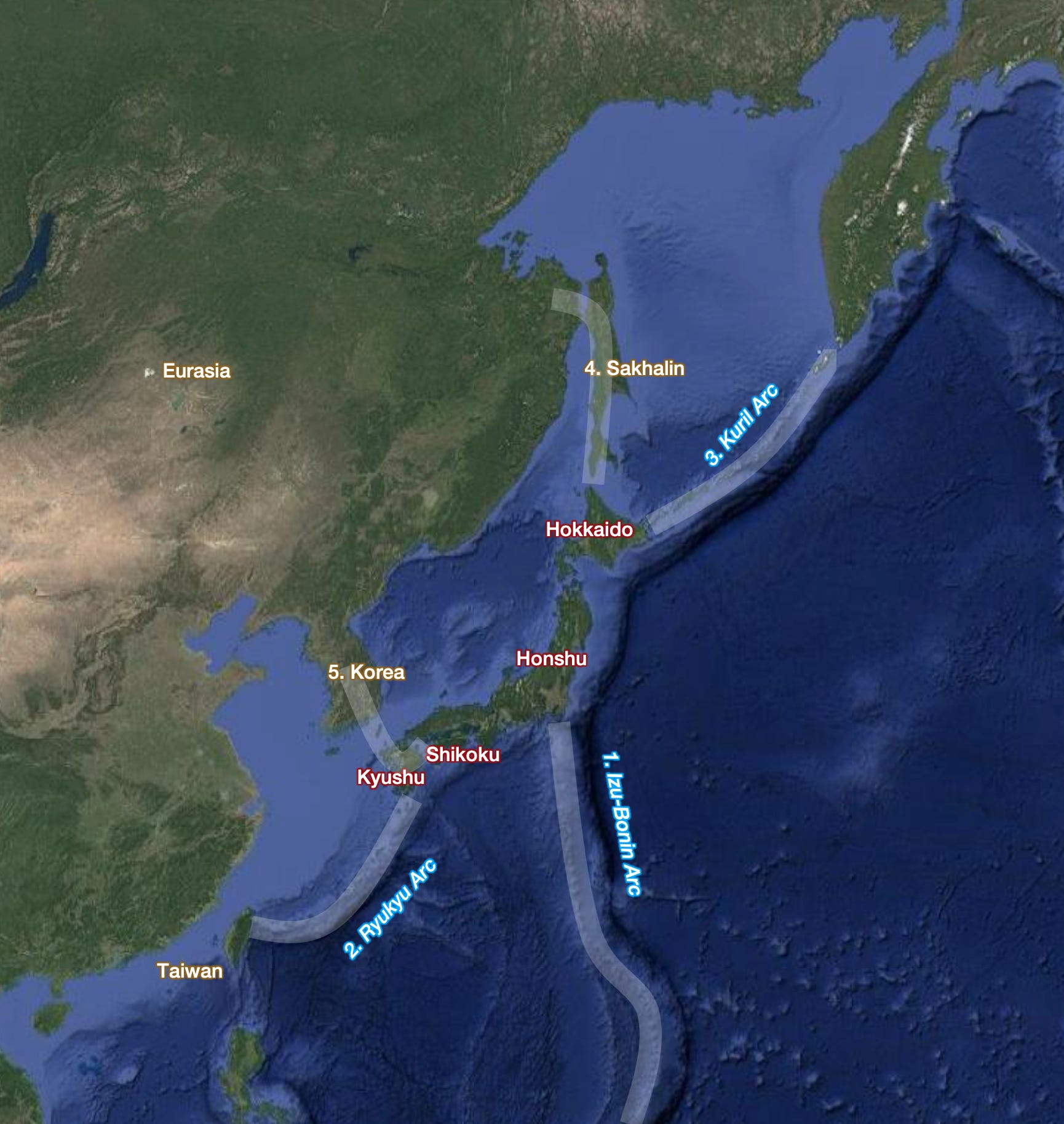
Spread out a map of Japan and its history is mostly guessable.
Start with the four islands
Honshu, Kyushu and Shikoku sit close together and all lie east-west, so they share a climate, a way of life and the same crops. They became one political unit over a thousand years ago. Hokkaido is far enough north to be different, and was only fully taken by the end of the 1800s.
And the islands are not drifting alone in the ocean. There are five routes in.
Five gates, and whoever holds them holds the advantage
The first runs east into the open Pacific. Nobody contests it, so it is Japanese by default. In WW2 the US approached Japan from the south along exactly this line.
The second is the Ryukyu chain, ending at Taiwan. Taiwan sits just 130 km off the mainland across treacherous water, and has always belonged to sea powers: the Dutch, the Spanish, the Koxinga regime, Japan. Most of that chain is Japanese today, which is why Okinawa is.
The third and fourth are the Kurils and Sakhalin, and who owns them depends on who won the last war. Russia got there first; Japan won in 1904 and took the southern half; Japan lost in 1945 and the USSR took it all back, leaving one Russian island just four kilometres off Hokkaido.
The fifth is Korea. Too mountainous for China to hold, too far for Japan to take easily, it was always going to be a buffer.
What really keeps Japan up at night
To the east and south there is nothing. To the north there is only cold. Every threat comes from the west, and so did every resource. Japan's geology is young, so there is almost no oil, and iron and rare earths all have to be bought. Even food falls short: over 60 percent of its calories are imported.
Everything arrives by sea. Which leaves Japan one calculation: keep the ships coming. Most of the missteps that led to WW2 came out of it.
Why it matters
Geography is not backdrop, it is a long-term constraint: a country repeating the same mistakes is often a country with no good options. Reading Japan's fixation on Taiwan, Okinawa and the Kurils directly beats reading a hundred diplomatic statements — it is never the islands it is fighting over, but the sea lanes that carry its food and ore.

Curated from high-quality sources, with concise summaries and key takeaways.

