Flu has arrived more than a month early in the northern hemisphere and is starting in the American West rather than the usual Southeast, while Covid wastewater has peaked and mosquito season is winding down.
The author is the public health team behind the newsletter Your Local Epidemiologist. This piece is a weather report on disease right now, and what an ordinary person should do about it.
Flu, early and in the wrong place
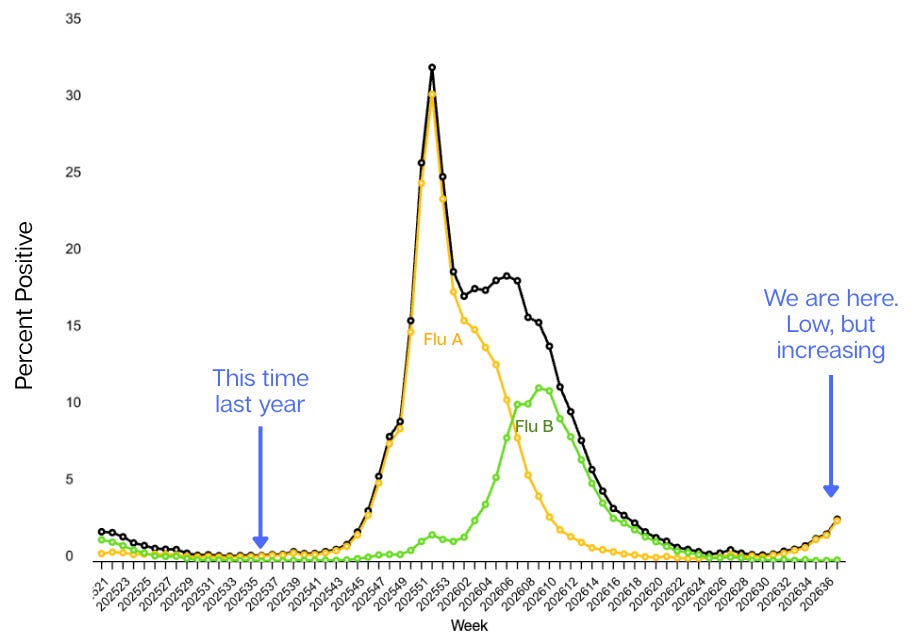
National flu levels are still low, but emergency department visits and other measures are climbing, especially in the West. Two things are odd: it is early, where the usual start is October or November; and it began in the West, not in Florida and Texas as it normally does before spreading outward.
The same is happening elsewhere in the northern hemisphere, including the UK and Japan.
Why? The southern hemisphere runs through winter a few months ahead of the north, so epidemiologists look south for clues. This year the south was messy too: Argentina started about three weeks early, Chile and South Africa were on schedule, and Australia and New Zealand stayed quiet through their usual window before surging in August and September. Australia had just come off its worst flu season on record, peaking right before Christmas, so immunity faded late and pushed this year's season back.
An early start does not guarantee a bad season, but experts will be watching closely. For everyone else the message is simple: get the flu shot now, rather than waiting for the usual October advice.
Covid is peaking, mosquitoes are nearly done
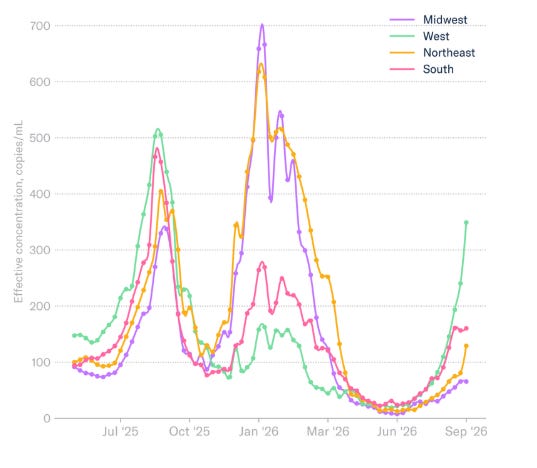
Wastewater is a strong indicator of how much Covid is spreading, and it has clearly peaked nationally. A few Midwestern states are still rising and will soon turn down. The author expects this summer's peak to match winter's but to fall short of last summer's.
Deaths keep falling, by roughly half each year. On that trend, Covid will have contributed to about 9,100 deaths this year, less than half the yearly toll from flu. The vaccine still matters, especially for high-risk people.
Mosquito-borne disease has been quieter nationally than last year, with one exception: Phoenix and California are well above last year. Activity peaks in August and is now trending down, though it continues until the first sustained cold snap. Use repellent at dusk and dump standing water weekly.
A few old rumours about the flu shot
'I got the flu from the shot.' Biologically impossible: the injection contains no live virus. The nasal spray uses a weakened live virus that cannot cause illness. In randomized trials, the only differences between the shot and a placebo were a sorer arm and more redness at the injection site. Most people who get sick were simply unlucky, infected in the two weeks before the shot takes effect.
'I don't need it.' Flu gets treated as trivial, but 3 to 11 percent of Americans catch it each year. Since 2010 that has meant 120,000 to 710,000 hospitalizations and 6,300 to 52,000 deaths annually.
'It doesn't work.' In well-matched years it is about 40 to 60 percent effective, and it is especially good at preventing severe illness and hospitalization. In 2019-2020 it is estimated to have prevented 7.5 million illnesses and 105,000 hospitalizations. A 2017 study found vaccination halved a child's risk of death.
'Last year's shot covers me.' The virus changes fast, the vaccine is updated annually and immunity wanes, so it has to be annual.
The piece also answers a reader whose friend's oncologist recommended the flu shot but not the Covid vaccine. The author says delaying vaccination for three months is right after a stem cell transplant or CAR T-cell therapy, but otherwise the advice is disappointing: people on immune-suppressing cancer treatment are exactly the ones at high risk of severe Covid.
Why it matters
A month sounds like a detail, but it decides when you book the shot: the vaccine takes two weeks to work, so waiting until the outbreak arrives hands the virus your unprotected window.

Curated from high-quality sources, with concise summaries and key takeaways.

