A lab worker in Siberia died of plague and nearly 200 contacts are quarantined. Pneumonic plague can pass between people, but it spreads poorly, antibiotics work, and the response was fast, so the odds of a pandemic are very low.

The Moscow Times reported that a 28-year-old worker at an anti-plague laboratory in Siberia died after exposure to plague, and nearly 200 contacts are under quarantine.
What plague is, and which kind this is
Plague is caused by Yersinia pestis, the same bacterium behind the Black Death, and it lives in wild rodents and their fleas.
It comes in three forms: bubonic, the most common, with painful swollen lymph nodes; septicemic, in the bloodstream; and pneumonic, in the lungs. Pneumonic is the most dangerous and the only one that spreads person to person. Early accounts point to pneumonic.
Why it is unlikely to go pandemic
Pneumonic plague spreads through respiratory droplets, but not efficiently. In past outbreaks one infected person typically infected one to three others, and it takes close, sustained face-to-face contact, such as nursing a patient or sleeping in crowded quarters.
It is not measles, which hangs in the air for hours. And antibiotics work very well against it. In July 2025 Arizona had a case after a man was exposed to sick cats; 46 contacts took preventive antibiotics and none fell ill. Madagascar in 2021 saw 22 confirmed cases and eight deaths, and antibiotics stopped it.
Russia's response looks quick: nearly 200 contacts under medical monitoring, reports of five hospitals under quarantine, and the institute sits in a small town rather than Moscow, so there is less contact between people.
Two things would raise concern. First, more cases. Pneumonic plague has an incubation period of one to four days, so if it spreads, that shows up this week. Second, whether the bacterium was altered. Russia has a history of bioweapons development, so that possibility is not entirely off the table.
Meanwhile, it is sick season
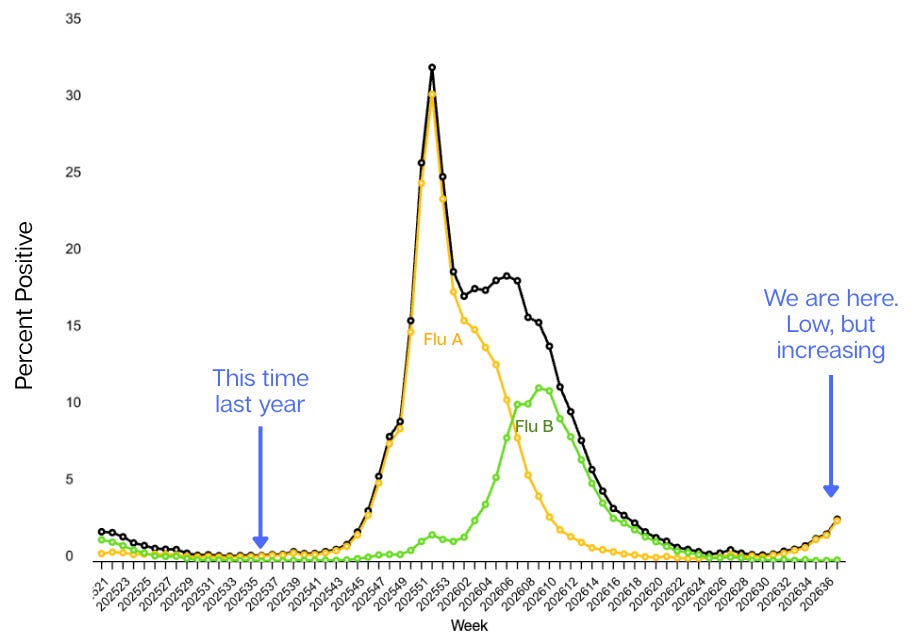
Flu is still low nationally but rising in almost every state, driven by H1N1pdm09. The circulating strain carries a mutation that may make the vaccine less effective in young people, but the shot is still worth getting.
The common cold is surging: 32% of physician tests are coming back positive for rhinovirus and enterovirus, the highest rate since 2019.
There is also a new synthetic opioid, cychlorphine. Test-tube data put it up to ten times stronger than fentanyl, at least 24 states have identified related overdoses or deaths, and one Tennessee county alone has reported 50 deaths. Fentanyl test strips do not detect it, but Narcan still works. Call 911, give a dose, and if there is no response after two to three minutes, give another.
One piece of good news: teen suicide risk is at a decade low, with 14% of high school students seriously considering suicide in 2025, down from 20% in 2023, and LGBTQ+ students down from 41% to 30%.
In one line: get your flu shot early, a runny nose is probably a cold, and the Russia story is worth watching but not among today's top ten worries.
Why it matters
Whether an outbreak runs away is judged by three hard numbers: how well it spreads, whether there is a drug that works, and how fast the local response comes. Plague scores well on all three this time, so the real risk is not the bacterium but the fact that no one outside Russia can independently verify what happened.

Curated from high-quality sources, with concise summaries and key takeaways.

