Morgan Stanley estimates that more than half of the GPU servers sold between 2026 and 2028 may have nowhere to draw power, as chips pile up years before their data centres are built.
Nvidia's earnings look lively: how many chips it sold, how much it made. But people have started asking an awkward question — did those chips ever get plugged in?
Two to three hundred billion dollars in warehouses
Fidelity's director of global macro says the AI trade has been dead money for over three months: token spending and GPU rental rates are flat to down.
Morgan Stanley did the arithmetic: more than half of the GPU servers sold between 2026 and 2028 may have nowhere to be plugged in.
Look further back and somewhere between $200bn and $300bn of Nvidia's sales since 2022 are sitting in warehouses, or unplugged in data centres.
Jefferies puts it more bluntly: the shortage is not just power but labour, transformers, cooling equipment and backup generation. Planned capacity and physical execution are separated by a chasm.
Two customers, paying with the vendor's own money
So who buys the chips? Microsoft, Google, Amazon, Meta and Oracle have each hoarded tens of billions of dollars of GPUs.
The moment new capacity comes online it is bought by OpenAI or Anthropic. Those two account for 70 to 80 per cent of all AI revenue and compute demand.
Better still, over the past nine months they received more than $217bn, the vast majority of it from Google, Amazon, Microsoft and Nvidia itself.
Money flows from the hyperscalers to the chipmakers, from the chipmakers to the two labs, and from the labs back to the hyperscalers as compute bills. It looks like demand outstripping supply.
The author estimates global compute demand unrelated to those two at roughly $22bn.
What holds the loop up
Venture capital does. AI startups do not make money; they survive on funding, and they supply 80 per cent of OpenAI's and Anthropic's enterprise revenue.
Meanwhile the two labs face nine-figure annual compute bills, payable only if the data centres get built and the customers can pay.
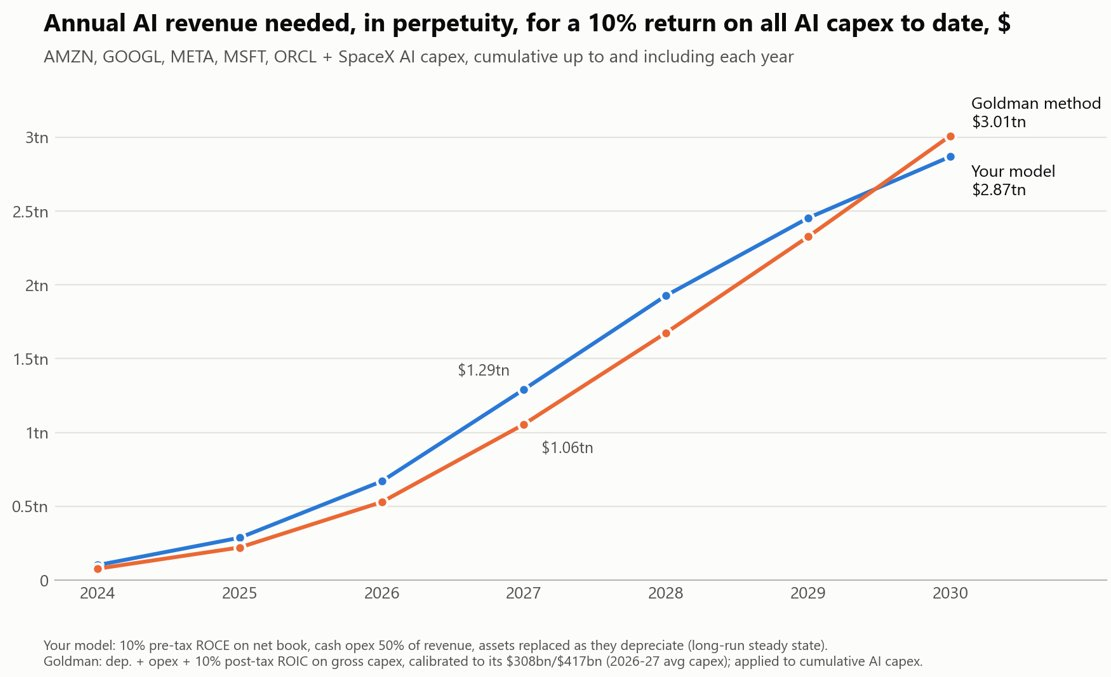
To break even on capex for 2026 and 2027 alone, the hyperscalers need $308bn a year in AI revenue, the author calculates. They are more than $100bn short.
And the money is getting dearer. Reissued today, Oracle's bonds would cost nearly $6.9bn more in interest; CoreWeave's could yield 11 to 13 per cent.
The dearer the debt, the more you must borrow; the more you borrow, the dearer the hardware; the dearer the hardware, the more you borrow. The author calls it the doom loop.
In one line: this is not booming AI demand. It is money circling among a few companies, and the longer it circles, the bigger the bill.
Why it matters
If the author is right, AI infrastructure is not meeting demand but manufacturing the appearance of it — hyperscalers borrow to buy chips, the chips feed two labs, and the labs pay rent with their next funding round. When the chain breaks, the first to suffer are ordinary holders of the related debt and equity.


Curated from high-quality sources, with concise summaries and key takeaways.

