To get a lighter frame built for distance running and a more flexible brain, humans cut the shock-absorbing material in their joints to a third or a quarter of what other great apes have.
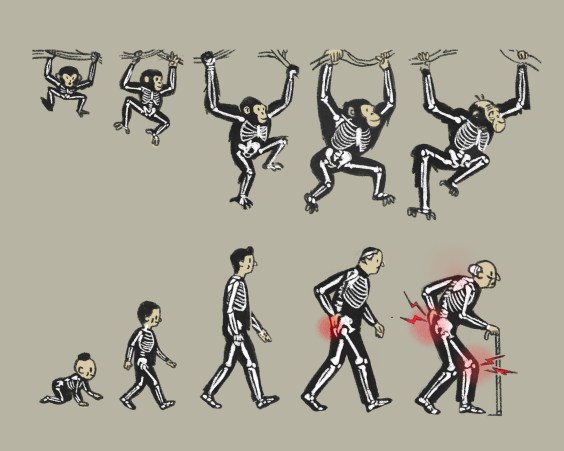
Stand up from the sofa and your knees crackle like a campfire. Stay on your feet too long and a sharp ache tells you to sit back down. This is not your particular problem; it is a design flaw in the whole species.
Gorillas hurt, we hurt more
Gorillas, chimps and orangutans have knees too, but they rarely get arthritis, even in old age. David Gokhman's team at the Weizmann Institute of Science wanted to know why. They ran two experiments: tagging more than 15,000 DNA segments with genetic barcodes to see which ones regulate genes, and fusing human and ape stem cells so they could be studied under identical conditions, then nudging them into becoming bone cells.
The result was the first atlas of how skeletal gene regulation differs between humans and great apes. The biggest divergence lay in molecules called glycosaminoglycans: feathery, negatively charged strands that soak up water and form the gel-like cushioning in cartilage.
Our shock absorbers are down to a third
The study found an entire group of GAG-producing genes is less active in humans. Across cartilage samples from eight joints, our levels run at a third to a quarter of those in gorillas, chimps and orangutans. Thinner, less springy cartilage follows, along with herniated discs and osteoarthritis. Gokhman calls it the most extreme genetic change our skeleton has undergone.
So what did we buy? Two hypotheses. First, lighter bones: swapping thick for slender may have made us worse at sprinting but better at running prey to exhaustion. Second, brains. GAGs also sit in neural tissue, stabilising connections and locking circuits in place; cutting them body-wide may have left our brains more plastic and quicker to learn.
In other words, we invested in the information sponge and paid with the joint sponge. Something to ponder while you ice your knees.
Why it matters
Evolution keeps no ledger of bargains, only of trades: the same changes that gave humans endurance running and faster learning left us the only great ape that gets arthritis. When your knees creak, at least know it is not bad posture. It is a debt owed by the species.
Curated from high-quality sources, with concise summaries and key takeaways.

