Goldman Sachs projects AI investment will hit 1.9% of US GDP in 2026, but nearly all of it is data-center construction and GPU sales, while renting compute and selling AI software barely registers.
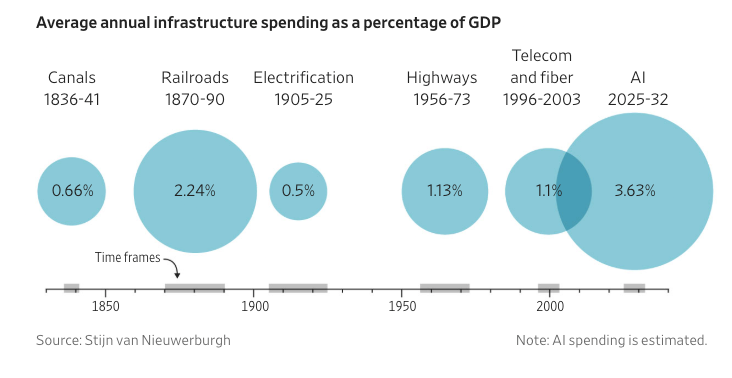
The Wall Street Journal ran a scary chart of how much of GDP AI will account for. The trouble is that the chart runs 2025 to 2032, so six of its eight years are guesses.
One number in it is usable: Goldman Sachs estimates AI investment will reach 1.9% of US GDP in 2026. The last time a single new industry built out that large a share of the economy was the railway boom of the 19th century.
The money goes into the buildings, not the AI
To be precise, that 1.9% is almost entirely data-center construction and GPU purchases. It has little to do with the companies that actually rent out that compute.
In other words, what is lifting US growth is AI's foundation, not AI itself. The problem is that foundations get finished. When construction slows, that slice of GDP disappears, and selling services or improving productivity has to cover the gap.
Is software really getting cheaper?
By the official measure, the information and communications industry's contribution to GDP has been flat for two years. All those GPU rentals and AI software sales in 2024 and 2025 did little on an economic basis.
Someone will say to look at real GDP. But the index the Bureau of Labor Statistics uses for software prices now sits lower than it was in 1997. Prices overall have roughly doubled since then. Software got cheaper?
The author counted, in another piece, that more than half of SaaS companies have raised prices every year since 2022, and in 2025 software inflation ran nine points above consumer inflation every single month.
Statisticians read a price rise as an upgrade
The formula treats a price increase as customers getting better software, so it does not count as inflation. That makes no sense to anyone who has recently used a Microsoft product.
Stranger still, it adjusts by cost. AI services burn expensive tokens, so a price rise for them is more easily recorded as no rise at all.
The upshot: software inflation is understated, and its contribution to GDP may be overstated. AI only makes this worse.
When the author compared the ICT industry's value added against real GDP, using the government's own flattering figures, the line barely steepened in the AI era.
In the end, nearly every economic analysis of AI's contribution rests on flawed data or flimsy assumptions. Everyone fixates on cost-per-token, teraflops and jobs numbers to avoid the ugly fact: strip out the capex and AI has had a negligible effect on GDP.
Why it matters
Take data-center construction out of GDP and AI's lift to the US economy is close to zero. The next people misled by that accounting could be investors sizing AI positions on it, or policymakers who conclude inflation is fine because software supposedly got cheaper.



Curated from high-quality sources, with concise summaries and key takeaways.

