Using single-cell sequencing data, biologists have constructed a real map of cell differentiation, showing that a metaphor sketched on paper seventy years ago describes a system that can be calculated and perhaps rewritten.
The cells that a fertilised egg divides into carry almost identical genes, yet some end up as liver and others as brain. If the genes are the same, where does the difference come from?
A metaphor sketched on paper
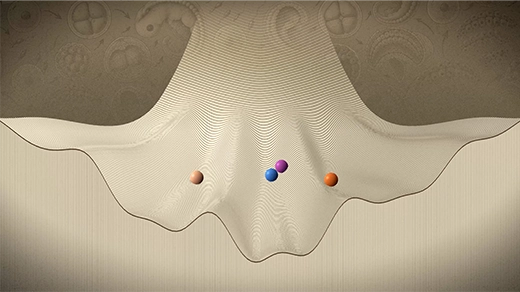
In the 1950s the British biologist C.H. Waddington offered an image: picture development as a mountain landscape with a ball rolling down from the top. At every fork the ball can take only one of the paths.
The ball is an early cell, the valleys are its possible fates. Which channel it rolls into decides what kind of cell it becomes. The fork is the moment the cell commits.
The picture was vivid, but nobody could run an experiment on it. It was a nice aphorism — impossible to compute, and impossible to falsify.
The data finally drew the mountains
The turn came with single-cell RNA sequencing. Researchers can now measure which genes are switched on in thousands of individual cells at once, then compress the result into a two-dimensional plot.
On such plots, blood cells, muscle cells and forebrain cells each clump together, and developing cells travel along paths that end in separate basins — almost exactly the shape of Waddington's valleys.
Mathematicians call those basins attractors: wherever the variables start, they get pulled in.
The landscape is not static — the cells push it themselves
The original picture was missing one thing: gravity. What force moves a cell along its path?
The answer is not a programme written into the genome. Every cell in an organism carries the same genome, so the order cannot be stored inside any single cell. It comes from cells talking back and forth — chemical signals, and the tugging and squeezing of membranes as tissues grow and fold.
So the landscape is not a fixed map. As cells move, they reshape the ground under their feet.
That map is already useful: if you know where the forks are, you can design ways to steer cells towards the state you want instead of guessing by trial and error. Some researchers are using it to think about coaxing cancer cells out of the cancer basin and back into differentiation.
In one line: Waddington drew more than a metaphor. He drew a terrain map you can actually navigate by.
Why it matters
If the paths cells take can genuinely be read and rewritten, cancer stops being an aberrant state that must be wiped out and becomes a place cells can visit and also leave. That shifts regenerative medicine, stem-cell work and cancer therapy from killing bad cells to redirecting a route.


Curated from high-quality sources, with concise summaries and key takeaways.

