Building AI data centers takes hundreds of billions in borrowed money, and most of the borrowers have no revenue, no credit, and nothing but their proximity to Nvidia or a hyperscaler to vouch for them.

AI companies borrow money to build data centers, but first you need to know what that business is: spend billions up front on land, power and GPUs, collect nothing for years, and rely on the promise of future returns to hold it together.
How junk debt got an AI engine
Junk bonds are simply debt rated below investment grade. The lower a ratings agency scores a company, the higher the interest it pays, because default is more likely.
Per SIFMA, the US issued about $303.4bn in high-yield debt in the first nine months of this year, against $222.1bn in all of 2011, or $329.6bn in today's money. The market has been swelling for six years.
The newest and most aggressive borrowers are AI labs. With negative cash flow and heavily concentrated customers, companies like OpenAI and Anthropic would likely land in the CCC tier, which means currently vulnerable and dependent on favourable conditions to meet obligations.
They will need $50bn to $100bn of annual issuance across junk bonds, private credit, leveraged loans and revolving credit lines. A fixed-income source says revolving credit is the kind of thing you only use as a last resort.
Who is actually carrying the risk
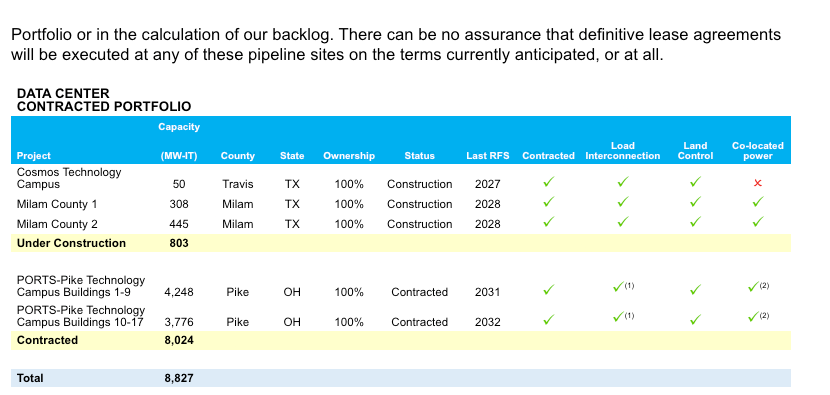
Besides the labs, there are the AI neoclouds: companies that raise piles of debt on a vague promise to build data centers someday, while more immediately buying GPUs years early and pumping up Nvidia's revenue.
CoreWeave alone, per UBS, needs to raise $102bn in debt through 2030. The railroad bubble of the 1800s involved roughly $250bn in total investment in today's terms, while hyperscalers alone are expected to issue $400bn in 2027.
Most companies building AI data centers range from low credit to no credit, their only creditworthiness being proximity to Nvidia or a hyperscaler that will inevitably become their customer.
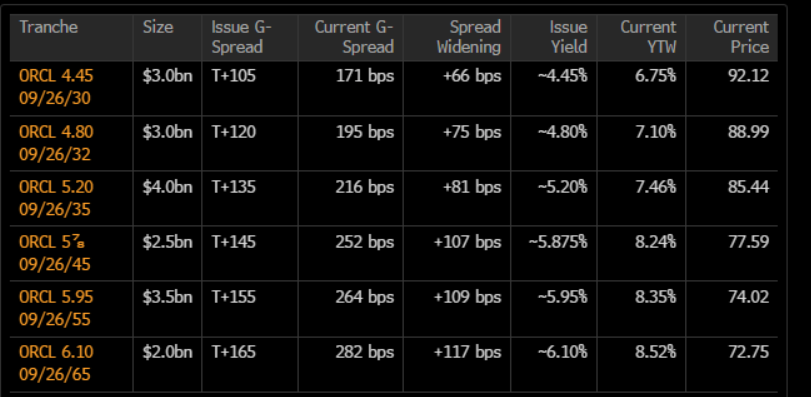
Oracle sits on the very last rung of investment grade. One more downgrade drops it into junk, and pension and investment funds would legally have to dump its debt en masse. Founder Larry Ellison has borrowed $30bn or more against Oracle stock, which means brutal margin calls if the shares slide.
S&P's downgrade note names OpenAI directly: it accounts for roughly half of Oracle's $638bn in remaining performance obligations, and whether it can pay depends on AI tailwinds continuing and its models staying on top.
Follow the threads and they meet in one place: the data center bubble, the software reckoning, some of the worst deals in history, all powered by leverage, with private credit and other investors set to lose billions.
Why it matters
The AI story is fuelled not only by equity but by debt. A downgrade can legally force pension funds to sell, and founders who borrowed against their stock get margin calls first. That risk sits inside ordinary retirement accounts, not just in tech headlines.
Curated from high-quality sources, with concise summaries and key takeaways.

