The placenta starts forming six to ten days after fertilization and is fully running by week twelve, making it the fetus's earliest life-support organ, ahead of the heart.
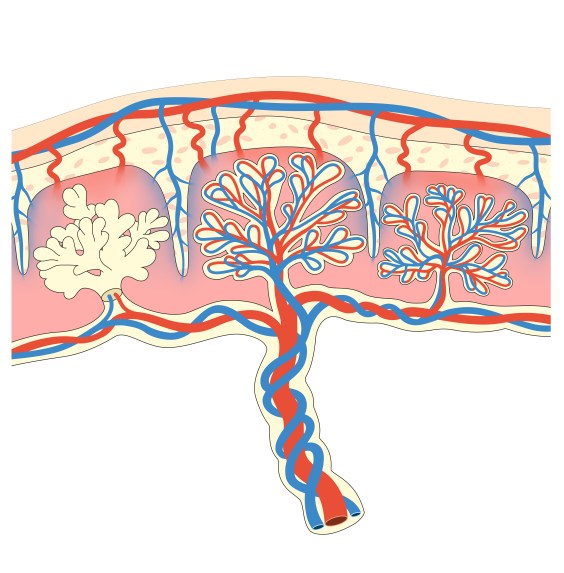
People say the placenta looks like broccoli, a tree, a pizza. In Latin, placenta means cake, which is closest: it really is a flat round disc.
Many ancient cultures treated it as sacred, holding the baby safe and carrying the original bond between mother and child. Hmong communities in Southeast Asia still bury it at home, believing that when a person dies their soul returns to its birthplace and reunites with the placenta, which then guides it onward. Most modern hospitals treat it as medical waste and send it straight to the incinerator.
It does the work of a whole set of organs
The placenta begins forming six to ten days after fertilization and is fully running by week twelve, earlier than the heart. Nearly all of its cells carry the baby's DNA; its origin is fetal.
The fetus cannot yet breathe, digest or clear waste, so the placenta stands in as its lungs, gut, liver and kidneys: it pulls oxygen and nutrients from the mother's blood, converts many into forms the baby can use, and passes them across, while carbon dioxide and waste travel the other way to be cleared by the mother's lungs and kidneys. The heart is the one pump the baby runs itself from around week three, but the force driving blood across those exchange surfaces comes from the fetal heart, not the placenta.
It is also the pregnancy's control centre, releasing hormones and cytokines that travel through the bloodstream and change how the mother's other organs behave.
A vicious cycle that locks in
Preeclampsia affects roughly 5 percent of pregnant women, marked by high blood pressure and protein in the urine, and in serious cases damage to multiple organs. One explanation: the placenta fails to build the blood vessels connecting it to the mother's circulation properly, leaving them narrower than normal and the supply short.
Early on, when the fetus is small and needs little, that reduced flow is not a problem. As the fetus grows, so do its demands, and the placenta signals the mother to send more blood. The supply is still insufficient, so it signals again — and the loop locks shut. Hypertension, swelling, headaches and vision problems follow. Studying the placenta means studying how this mechanism breaks.
Cancer cells are running the placenta's playbook
Placental cells divide fast, invade the lining of the uterus, grow new blood vessels to feed themselves, and slip past the mother's immune system. So do cancer cells.
The goals are nothing alike: placental cells are controlled, coordinated and precise, the condition for a fetus to survive. Cancer cells multiply without restraint and destroy the host. They simply use similar strategies. That is why projects such as the NIH Human Placenta Project are now funding work on how the placenta shapes the health of both mother and child for life.
The author's own lab has found that placental hormones remodel the mother's brain to prepare for pregnancy, birth and the postpartum period. That conversation between placenta and brain is still not fully read — and maternal mental health may be one of the things hidden inside it.
Why it matters
Placenta research has long sat in a small drawer marked obstetrics, but it opens onto bigger questions: how blood vessels grow, how the immune system gets evaded, how one organ can spend months standing in for someone else's lungs, liver and kidneys. Get those mechanisms clear and the beneficiaries are not only pregnant women.


Curated from high-quality sources, with concise summaries and key takeaways.

