Israel's president pardoned Elor Azaria, the soldier who shot a wounded Palestinian in the head in 2016 — not an aberration, but the latest instance of a practice nearly eighty years old.
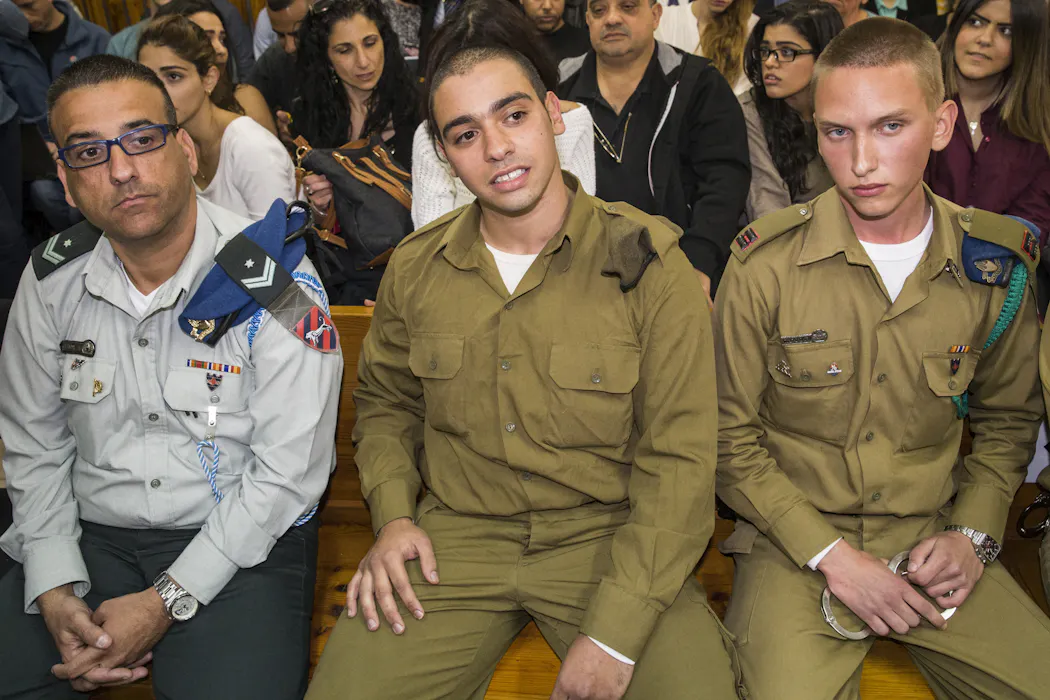
In March 2016 in Hebron, in the occupied West Bank, a Palestinian named Abdel Fattah al-Sharif stabbed an Israeli soldier, was shot and lay wounded on the ground. Minutes later, soldier Elor Azaria walked up and shot him in the head. Video of the killing spread everywhere.
Convicted, then effectively unpunished
In 2017 a military court convicted Azaria of manslaughter and gave him 18 months. He served nine. On Sept. 19, 2026, President Isaac Herzog pardoned him, citing the years that had passed, the remorse Azaria expressed in his application, and the approaching Yom Kippur.
But after his release Azaria said publicly he would act the same way again. The pardon erases the record, not just the sentence.
An eighty-year template
In 1948, Israeli commander Shmuel Lahis was convicted of murdering 15 villagers in Lebanon and sentenced to seven years. On appeal it became one year; President Chaim Weizmann cancelled the sentence in 1950, and five years later President Yitzhak Ben-Zvi pardoned him outright. By 1978 Lahis was director general of the Jewish Agency.
In 1956 at Kafr Qasim, Israeli border police killed 47 Palestinian citizens of Israel during a curfew. Eight troops were convicted and given seven to 17 years. Within 18 months all were free; none served more than three years and four months.
Human rights groups documented that between the start of the second intifada in 2000 and March 2011, Israeli forces killed at least 3,024 Palestinians in the West Bank and Gaza who were not taking part in combat. Twelve soldiers were indicted. Not one was convicted of murder.
The author's research across a longer span concludes that in Israel's history, the longest a soldier or policeman ever actually served for killing a Palestinian was three years and four months.
Why it matters
The point of pardoning one man is not the man. It is the signal sent to soldiers on duty in the West Bank right now: killing a Palestinian is forgivable. When conviction is already the exception, a pardon folds that exception into the state's moral order.


Curated from high-quality sources, with concise summaries and key takeaways.

