A study of more than 2,600 people and over 12 million white blood cells found that immune ageing is not just a loss of rookies — the veterans that replace them split into two types, and more of one predicts higher mortality.
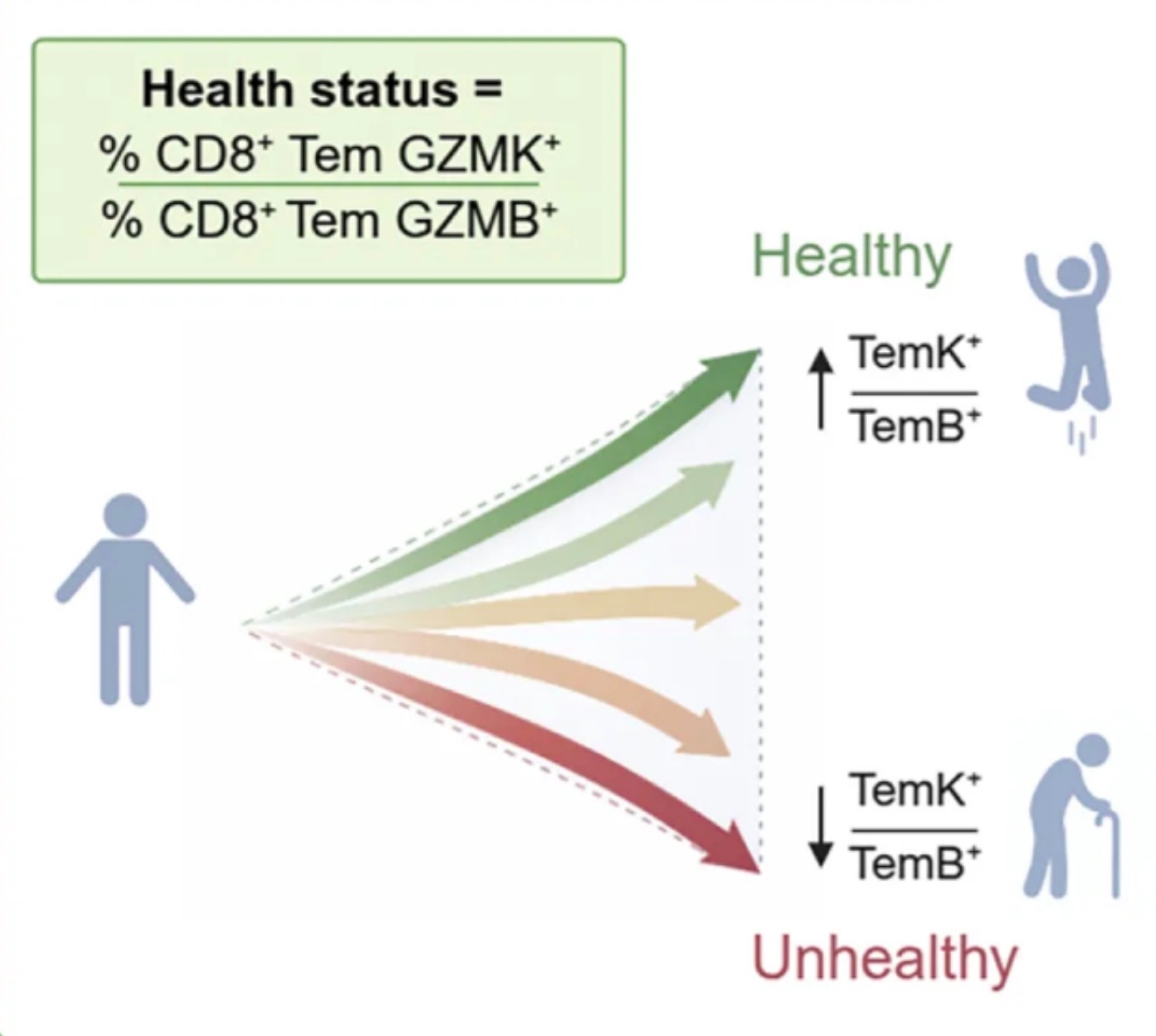
In October 2026 a paper with a title that reads like line noise appeared in the journal Immunity. It is about how the immune system ages.
Meet the two leads: the rookies and the veterans. The rookies are naive T cells, made by an organ called the thymus. The thymus starts shrinking after puberty, so rookies get scarcer — and that decline alone roughly predicts your age.
Veterans come in two kinds
When rookies run short, the body sends in veterans. These are effector memory T cells. Older methods could not tell them apart; single-cell sequencing could, and it split them into two groups.
One carries granules of GZMK, the other of GZMB. The second kind is trouble: it leaks, and what spills out damages tissue and stirs up inflammation. Think of a unit that smashes the furniture wherever it goes.
What pushes rookies down that path? Cytomegalovirus, and chronic conditions such as cardiovascular disease and type 2 diabetes.
One blood marker, mortality
The team found a cheaper proxy: measure proteins in blood. Among 48,620 UK Biobank participants, those with a high share of the bad veterans had clearly higher all-cause mortality over 17 years.
Oddly, the marker had almost no predictive power for Alzheimer's, Parkinson's or macular degeneration. The authors are careful: this is correlation, not cause.
Can we measure the immune system now?
Mostly not. Medicine can dial the immune system up or down, but it cannot read its current state in a clinic.
This study is a third route: a cheap blood test for the ratio of bad veterans to good ones. Together with reading the thymus off a chest CT with AI, it is heading toward clinical use.
Why it matters
The immune system is one of the few things in medicine you can adjust but not measure: there are dozens of drugs to push it down or rouse it, yet no routine number that says how old it is. This turns immune age into a figure you can get from a blood draw — and once it is measurable, diet, vaccines and exercise finally have a target you can check.

Curated from high-quality sources, with concise summaries and key takeaways.

