Fungal networks trade nutrients with plants and sequester about 13 billion tonnes of CO₂ each year, roughly a third of global fossil-fuel emissions.
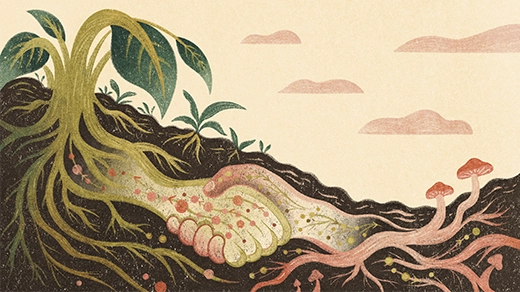
The soil beneath our feet is far from dead. There, mycorrhizal fungi have been running a 450-million-year-old trade with plant roots: plants pay in sugar and fat, fungi pay in phosphorus and nitrogen.
Evolutionary biologist Toby Kiers uses economics and game theory to study how these brainless organisms choose partners, set prices, and even hoard resources.
A silent negotiation
In the lab, Kiers tags phosphorus with fluorescent quantum dots and watches fungi move it from resource-rich zones to other parts of the network where a plant is willing to 'pay' more carbon.
Fungi even discriminate against shaded plants that can't deliver enough carbon. This isn't punishment; it's an evolved strategy.
Earth's hidden circulatory system
These networks process about 13 billion tonnes of CO₂ a year — a third of global fossil-fuel emissions. They carry carbon deep into the soil and produce sticky compounds that lock it away.
Without them, soil would erode and crops would struggle. The phosphorus in our own DNA once passed through a fungal network.
The invisible world we ignore
59% of all species on Earth live underground, yet 90% of mycorrhizal biodiversity hotspots lie outside protected areas.
Kiers founded SPUN, a global network of over 600 scientists mapping underground fungi, hoping to make this hidden world visible — and worth protecting.
Why it matters
Fungal networks handle a third of the world's fossil-fuel emissions each year in carbon, yet they barely feature in conservation planning. Protecting only the biodiversity we can see means losing the planet's most powerful underground carbon pump.



Curated from high-quality sources, with concise summaries and key takeaways.

