What began as a school strike over three unfilled teaching posts became nationwide riots, and the real culprit is that a third of France's education budget never reaches a classroom.
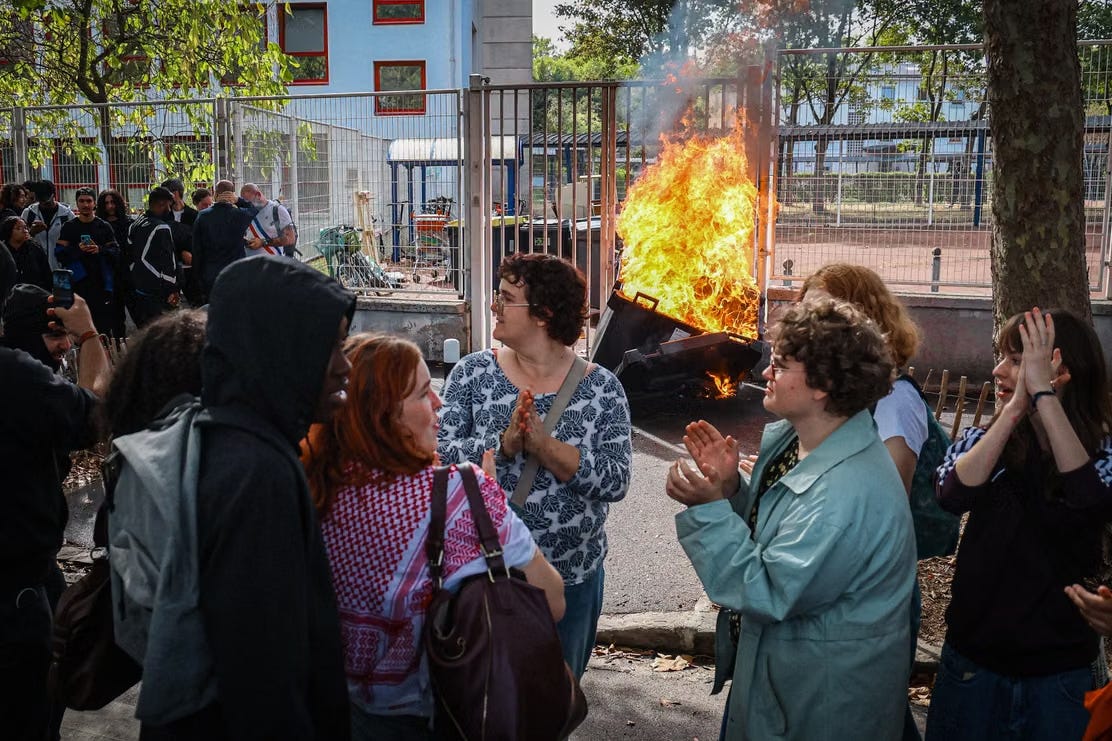
In late September, at a school in Créteil on the outskirts of Paris, three of more than 130 teaching posts were unfilled, and the teachers walked out. The unions followed, the far-left party La France Insoumise followed, and the students followed. Protests spread from high schools to universities and then across the country.
Where the money actually goes
Students complain about crumbling buildings, missing teachers and oversized classes. Yet France spends $13,787 per pupil a year, above the OECD average, and a larger share of GDP than South Korea, Germany or Canada.
The money is spent, just not on students. About 32% of the education ministry's budget goes into pensions. A teacher costs the state around €85,000 a year, takes home €37,000, and €30,000 of the rest goes to retirement contributions.
The French retire early and well. Pensioners make about 90% of the average worker's income, teachers retire at 62, some at 61, and the French live to about 83.
Discrimination is real, but racism is not the whole story
Immigrant students in France underperform, face more unemployment, and are overrepresented in social housing. The right blames the immigrants, the left blames discrimination, and each side is half right.
A comparison of school data shows that the higher the immigrant share, the more fighting and disorder. Control for family income, though, and that link halves; for fighting it falls to nearly zero. Poverty does the work, not skin colour.
Yet Vietnamese and Chinese immigrants who arrived decades ago, just as poor, now match natives in income, schooling and crime. The problem starts with lower human capital from certain origin countries, combines with suburban ghettoisation, and spirals.
Who turns protests into riots
In the first wave of arrests, 87% were minors, mostly students. By last weekend only 27% were minors; adult men had joined the looting. One shopkeeper whose store was smashed said he stood in the broken window for six or seven hours and heard no political demand at all, only insults and laughter.
La France Insoumise has an election to win in April 2027, and chaos brings attention. Between 20% and 60% of its voters are Muslim, so it defends violent protesters without fail.
Police brutality? Over 70% of the injured were police: by 14 October, 937 officers, 250 students and 150 education staff.
Sentences are light too. In Marseille, the chance a rioter is arrested is around 1%. An 18-year-old who threw a Molotov cocktail at police faced a maximum of 10 years and got 12 months suspended plus 140 hours of community service.
So what should France do
On money: cut entitlements, above all by raising the retirement age, rather than adding more. On discrimination: some of it reflects real information, and normalising high-school grades across schools would help. On riots: police arrest too few and courts sentence too lightly, and repeat offenders and undocumented migrants should not walk away.
Why it matters
A generous welfare state that sends a third of its school budget to pensioners, who then take home more than the teachers still working, will eventually have that arithmetic done in the street. France's problem today is the sum facing every ageing welfare state: not whether to cut, but how long it can wait.


Curated from high-quality sources, with concise summaries and key takeaways.

