Thursday, 12 November 2026
Dozens of blogs and magazines, read for you every morning — the few worth talking about

50 Korun banknote of Czechoslovakia, issued in 1929 by the National Bank of Czechoslovakia
National Museum of American History · Wikimedia Commons · Public domain
Nvidia CEO Jensen Huang resigned after revelations of two extramarital affairs, one with a woman suspected of smuggling chips to China and of being a spy, sending the company's stock tumbling and removing the AI boom's stabilising force.

Taoyuan uses AI to read photos of exhaust pipes and catch illegally modified vehicles; complaints are down 20% on last year. When an ambulance approaches, the lights turn green on their own and average travel time drops from four minutes to just over two.
What surprised me most is the mayor's line: he will not sanction generative chatbots that could hallucinate, and lets AI identify what is already there, never to forecast an individual's future.
Princeton's Narayanan puts it more bluntly: much AI prediction is decision-making by Magic 8 ball.

Qilin is the most active ransomware gang right now, claiming at least 365 victim organisations in the past three months alone. Its administrator goes by Haise on forums, but an earlier handle was Rjun, tied to the email address mail-30a@mail.ru.
That address turns up in leaked records from gosuslugi.ru, Russia's official government services platform, pointing to 36-year-old Aleksey Mikhailovich Yakovtsev in St Petersburg.
A decade-old email is what linked Haise to a real identity. What surprises me is that he wasn't caught by his technical skill; he just forgot to cut the old thread when he changed handles.

To find out what habitual coffee drinking actually does to the gut, researchers at the University of Copenhagen had people swallow an electronic pill that measured temperature, pH and intestinal contractions along the way.
Habitual drinkers had a more diverse gut microbiome and a more acidic small intestine; the more concrete finding was more colon contractions — yet transit time was about the same for both groups, so same train, a bumpier ride on the coffee line.
The sample was small and the authors call the work exploratory. Still, I suspect a gentler treatment for constipation may be sitting in the morning cup.

Is a single bug worth fixing with AI? House House used a large language model to get an idea for a Unity 'infinite shadow' bug, and the code that shipped is 10 lines, under 0.1% of the whole game.
Nineteen of the Independent Games Festival's 50-plus jurors signed a statement refusing to vote for any game that uses generative AI in any capacity. One wrote that even this much outweighs the respect they have for the work itself.
Another juror said what bothers them is that people who own up to a small mistake get punished harder than those who hide it from start to finish.

A founder and writer traces the AI shock to white-collar work step by step: start with SaaS, where one person with Claude can rebuild a whole product, and ask why a company would keep paying thousands a year.
The truly uncomfortable part is not job loss but pricing: if AI lets a tax advisor serve 500 clients instead of 50, supply goes up tenfold, prices collapse, and even the advisors end up earning less.
The author worries about himself too: today AI lets him make animation fast and cheap, tomorrow someone can clone him the same way. What I most want to know after reading is which of the 16 moats he found can actually hold.

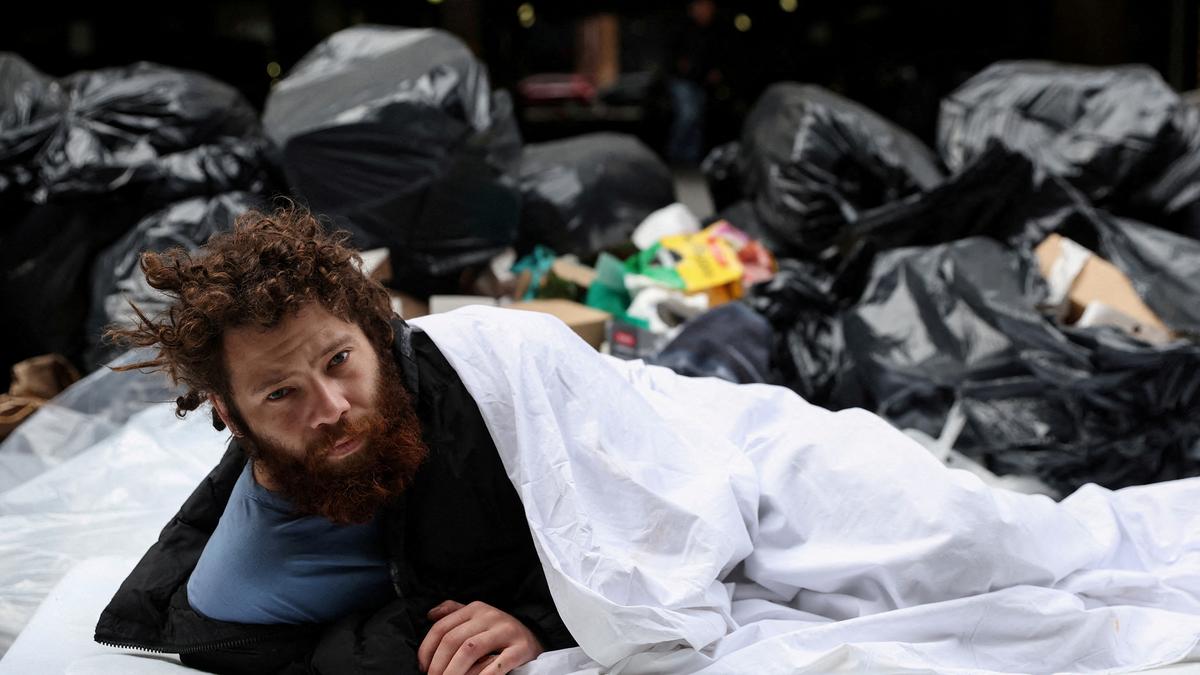
Unhoused people are often treated as grime on the cityscape. This piece argues that is not just poverty but 'aesthetic injustice': people deciding who deserves respect by how someone looks.
In Ottawa, Canada, officers were authorised to remove unhoused people from parks on 'beautification' grounds, and one study reports they 'approach homeless people as garbage'.
What stopped me was the conclusion: society owes them not only shelter but a razor, a shower, a change of clean clothes, so they get some say in how they are seen.
Bukele asked on social media, in Haitian Creole, for the address of gang leader Wilson Joseph, then posted footage of attack helicopters firing on a compound near Port-au-Prince. The operation, reportedly conducted with Haitian police, killed as many as 20 people, though Joseph was reportedly absent.
The trigger was the disappearance of four Salvadoran aviation technicians in an October gang ambush. But around 2,500 troops now operate outside the command of the UN-authorized Gang Suppression Force, and neither government has published a deployment agreement.
What I want to know is this: with the rules of war applied to a policing fight, and El Salvador's 1.7% incarceration rate shipped overseas, who holds the ground once it is taken?

The four hosts of All-In spent an entire episode trying to work out why Americans are so angry, and concluded that it is a 'narrative' problem.
What surprised me most was David Sacks saying that without the podcast circuit, conservatives have no media that supports them. Fox News, the Washington Post and X presumably do not count.
The earnestness with which they discuss giving 'the wage-earning class more ownership of the US economy' is funnier than any satire.

“AI snake oil is appealing because those buying it are in broken institutions and are desperate for a quick fix.”
“But even those cautious criminals will sometimes have to reference their past monikers when applying for membership at a new forum.”
“Frequent coffee consumption appears to affect the physiology of the gut itself, in other words how the gut functions.”
“They realize that the AI can prompt better than them, at which point they end up just clicking on Proceed every time the AI asks them something.”
“Without a shower, a razor, a change of clean clothes, unhoused individuals are denied what those lucky enough to be housed take for granted: a say in how to appear to the world.”
“The Salvadoran model has relied on emergency powers and mass incarceration. Around 1.7% of Salvadorans are imprisoned – by far the highest rate in the world.”

