Once Anthropic and OpenAI list, they will need at least $50 billion of debt a year, and their actual finances point only to a junk rating.
Start with Treasuries: the Treasury auctions ten-year notes every month, and that interest rate is the starting line for borrowing worldwide.
That line is moving up. The government owes over $40 trillion, interest alone eats 14% of federal spending, and it borrows another $2 trillion a year. The wars in Iran and Ukraine push oil and shipping costs higher. Put together, Treasury yields climb and everyone pays more to borrow.
A company always pays the benchmark plus a markup
When a company issues debt, its rate equals the ten-year Treasury plus a spread for risk. When the benchmark rises, the spread rises too, and the borrower gets hit from both sides.
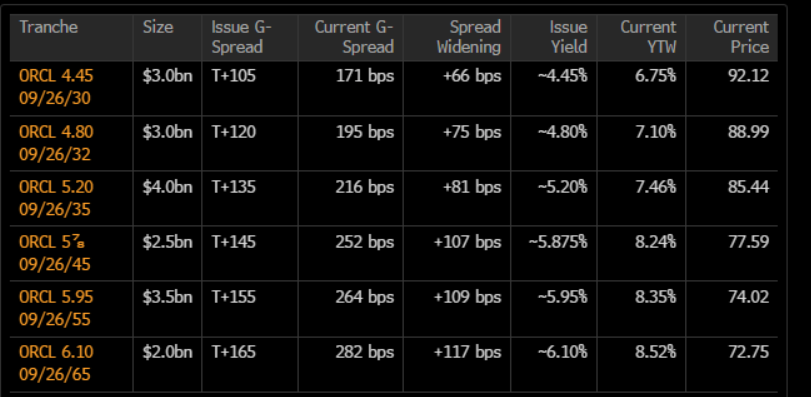
Oracle is the live example: on the $18 billion it sold last September, extra interest now runs past $7 billion. Its bonds trade like junk, with yields near the 8.2% high-yield average.
Worse are AI-only compute firms like CoreWeave, whose spreads run from 6.72% to 8.82%, with its shortest four-year debt yielding 11.53%.
The old money is getting picky
Data center financing is getting harder. The Information reports that Societe Generale, Sumitomo Mitsui and Mitsubishi UFJ are becoming more selective.
One detail says it all: Blue Owl executives agreed to invest up to $10 billion in future projects just 15 minutes into their first meeting with a developer. That was the depth of the due diligence.
Projects without a hyperscaler guarantee now face rates of 9% to 14%, on an asset class that already runs on thin margins.
How the two AI labs would pay it back
Here is the problem. Anthropic and OpenAI own no data centers, no chips, not even their offices. There is nothing to pledge as collateral.
OpenAI lost $20.9 billion on operations in 2025, an EBITDA margin of negative 160%. On any rating scale, that ends the conversation.
To borrow at all, a hyperscaler would have to guarantee the debt, or a connected special-purpose vehicle would have to package customer contracts and sell them on. Either route goes around the rules ratings agencies wrote for themselves.
And there is a $1.3 trillion bill
Anthropic holds $413 billion in non-cancellable compute contracts; OpenAI is set to spend at least $750 billion on compute through 2030. Creditors already treat those payment obligations as debt.
Meanwhile 50% to 60% of Nvidia's revenue comes from hyperscalers, whose hypergrowth story rests on OpenAI and Anthropic. One failure shakes the whole chain.
The piece ends on a chart from Apollo's chief economist: analysts expect tech operating cash flow to double to $2.4 trillion by 2028, while analysts covering the customers who would pay for those services expect only modest growth. Both cannot be right.
You cannot pay a $1.3 trillion bill with hope.
Why it matters
The danger in the AI boom is not the valuations, it is that the buildout was financed with borrowed money. When the benchmark rate and the risk premium rise at the same time, the first thing to break is not the share price but the companies holding non-cancellable contracts and no assets to pledge.


Curated from high-quality sources, with concise summaries and key takeaways.

