Astronomers traced a millisecond radio flash back to its host galaxy, the most distant fast radio burst yet pinned to a source.
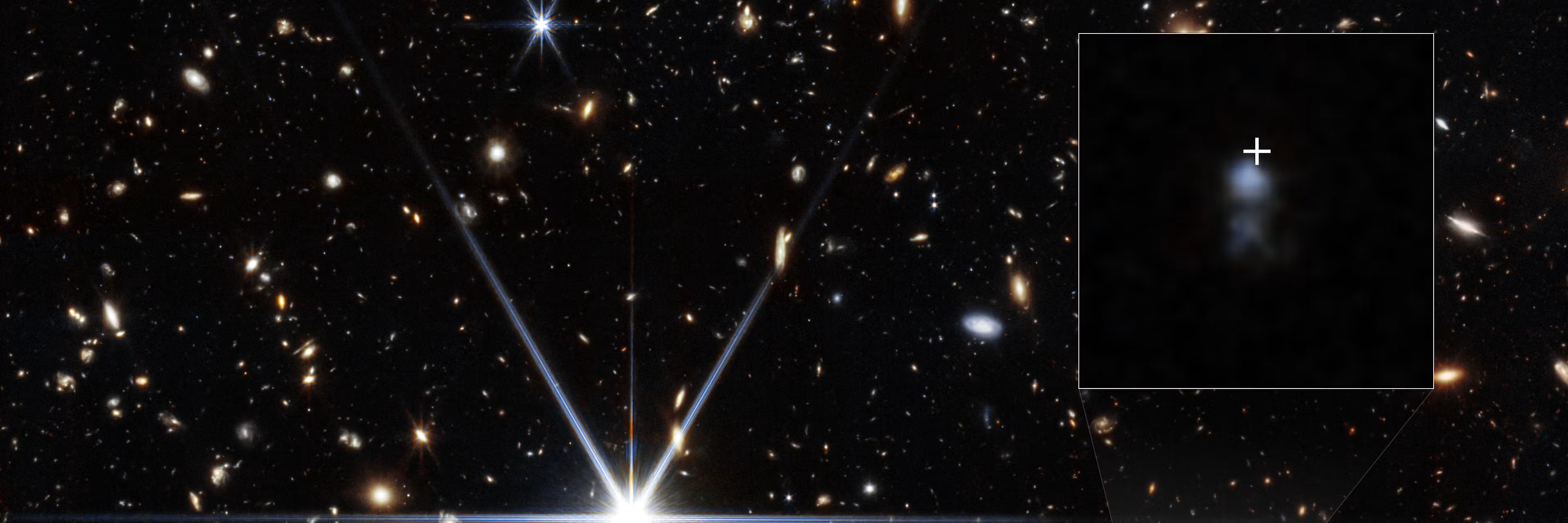
More than ten billion years ago, something in a distant galaxy threw off an extremely bright burst of radio waves lasting just a few milliseconds. New research in Science has tracked it back to where it came from.
How they knew how far it had travelled
Different frequencies of the radio burst arrived at slightly different times, an effect called dispersion: the more electrically charged material the signal passes through, the wider that gap. Measure the dispersion and you can work out how far it has come. This burst showed a lot of it, so it was probably very distant.
The team caught it with the MeerKAT radio telescope in South Africa, then looked for the host galaxy with ground-based telescopes like Keck and saw nothing — it was too faint. Only the James Webb Space Telescope's infrared camera revealed a tiny galaxy right beside the burst's position.
Breaking that galaxy's light into a spectrum and comparing how the frequencies shifted gives its speed away from us, and from there its age: 10.6 billion years. We are seeing it as it was when the universe was one-fifth its present age.
A galaxy that should not be this small
The host galaxy holds only about ten million times the mass of our Sun, a rounding error next to the Milky Way. It is young, still forming stars heavily, and very low in metals — nothing like the larger galaxies where most fast radio bursts have been found.
That fits one explanation: at least some of these bursts come from young, highly magnetised neutron stars called magnetars. But fast radio bursts come in many shapes, and they probably do not all share one origin.
It is really a torch
What may matter most is not the distance but the record left along the way. As the signal travelled, it picked up the imprint of everything it passed through. Magnetic fields subtly twist the orientation of its radio waves, and measuring that twist reveals how complex the magnetic field is across billions of light-years.
It also shows how charged matter is spread through the cosmos. This detection proves fast radio bursts were being produced around three billion years after the Big Bang, when stars and galaxies were forming fastest. One flash lets astronomers probe charged matter across roughly 80 percent of cosmic history.
The next step is to find many more. With a large enough sample, these brief flashes become signposts for how matter is spread out and how galaxies grow.
Why it matters
The value of a fast radio burst is not the burst itself but the fact that it works as a probe: every flash records a line through the cosmos, handing astronomers a free observation stretching billions of light-years.


Curated from high-quality sources, with concise summaries and key takeaways.

