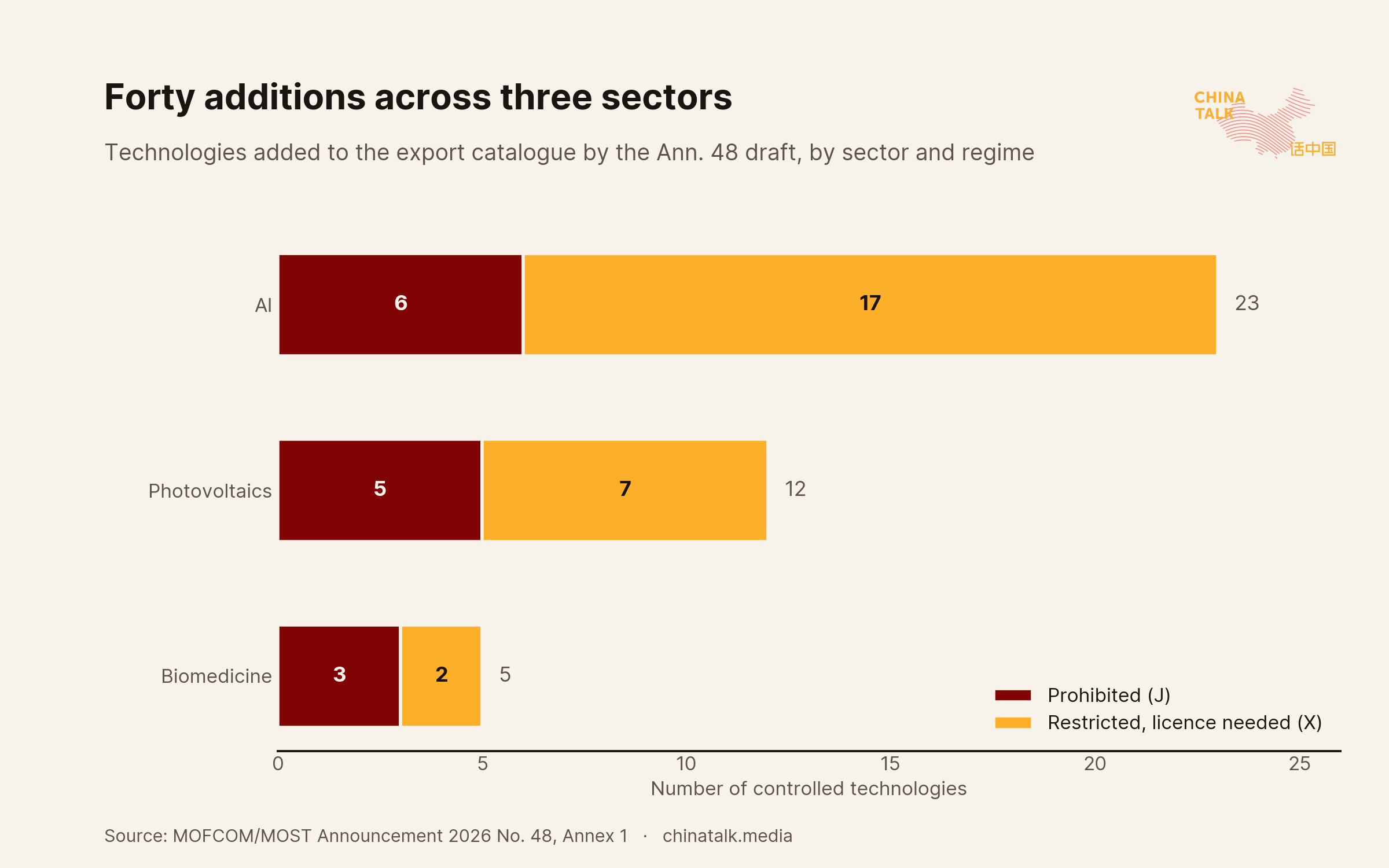
China's commerce and science ministries plan to ban exports of 14 AI technologies and license 26 more, covering frontier models, chip design and training data, with pre-export registration starting immediately.
Chinese AI companies built a global following by open-sourcing their models. Now Beijing wants to keep an eye on that portfolio.
Register first, license later
On October 16, MOFCOM issued Announcement 48 of 2026, proposing 40 new additions to the export control catalogue: 14 outright prohibitions and 26 requiring licences. Until the rules take effect, every export involving these technologies must be registered first.
Registration covers transferring ownership abroad, licensing technology to foreign firms, and handing control of a domestic company to a foreign entity. The message is blunt: moving to Singapore does not put you beyond Chinese jurisdiction.
The model thresholds
A model is caught if it clears any one of three bars: 10^26 floating point operations in training, two trillion parameters, or 'global leading capability'.
No released Chinese model has crossed the compute line yet; the closest sits around 2x10^25. Only Kimi K3, ERNIE 5.0 and two others pass the parameter test.
Weights already published are outside the rule, but training code, optimisation methods and inference acceleration still need a licence. Open source, in other words, is open source under licence.
Chips and data, a separate ledger
Chip design is covered at 14 nanometres and below, along with 2.5D or 3D packaging and compute-in-memory architectures. The last one could let China sidestep the high-end memory blockade, so it is being locked down before rivals catch up.
Training data follows the Data Security Law: models trained on 'core data' cannot be exported at all, and those trained on 'important data' need a licence.
One surprise entry: translation and voiceprint recognition for ethnic minority languages. Mandarin-centric censorship has gaps in smaller languages, and AI is both a tool and a patch.
The point is not to hit the brakes. Open sourcing, self-run overseas data centres and overseas chip fabrication all get a fast track. The real message is that China now believes it has technology worth protecting.
Why it matters
Export controls used to be about slowing someone else down. Turning them inward is an admission that the technology is no longer just catching up — and that says more about where Chinese AI stands than any product launch.
Curated from high-quality sources, with concise summaries and key takeaways.

