America's creative industries have shed over 200,000 jobs in four years, with Hollywood down nearly a third of its workforce — and this time the competition is a model that works for free.
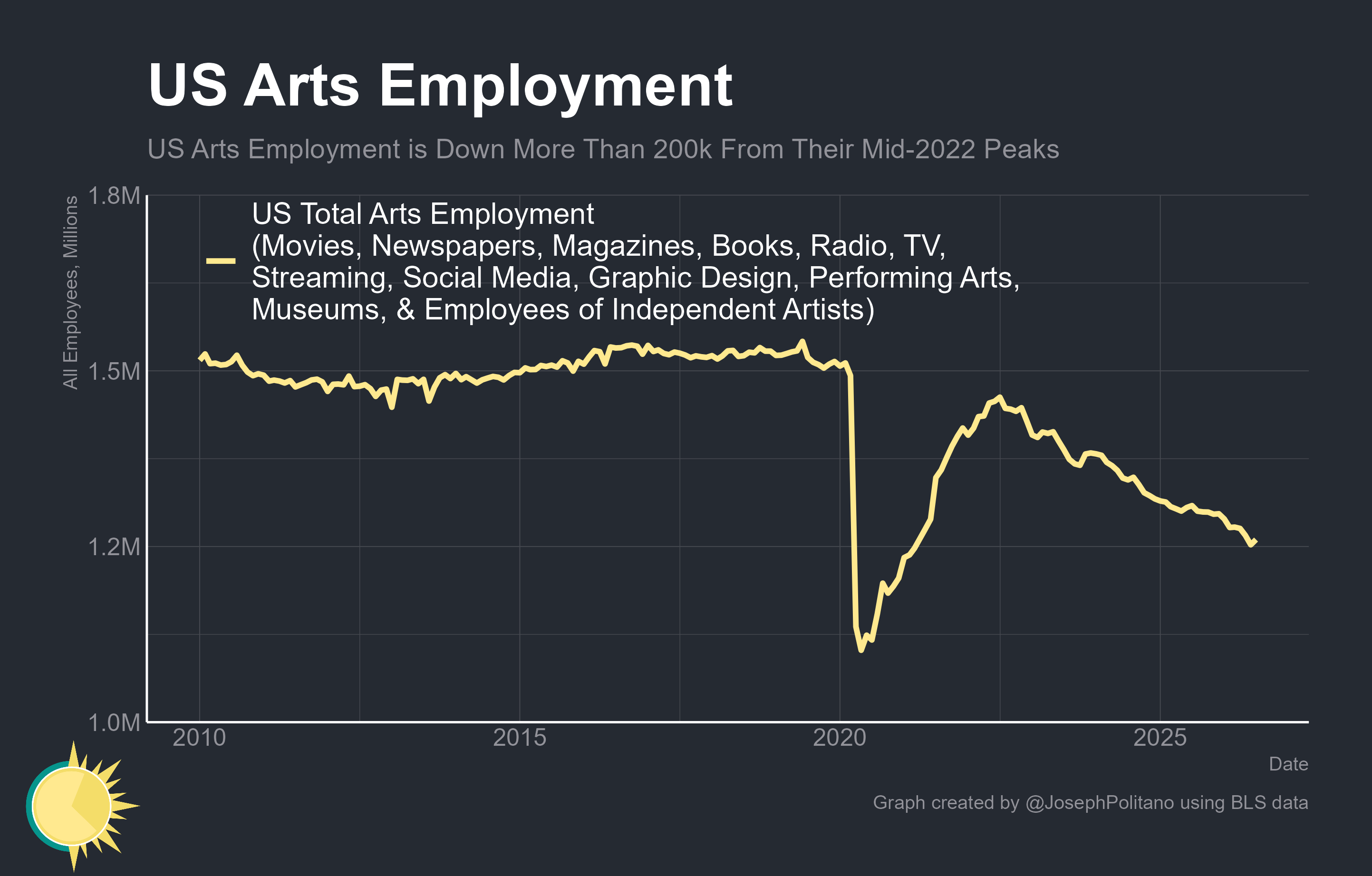
Over the past four years America's creative industries have lost more than 200,000 jobs, roughly 50,000 of them in the last year alone. The only comparable stretches of media layoffs in modern US history were the recessions of 2001 and 2008.
Who is actually being cut
Movie and sound recording took the worst of it: more than 100,000 jobs gone in three years, nearly a third of the sector. At this summer's low, employment was below its 2008 crisis level and close to a 30-year trough.
Publishing came second, down more than 70,000 over the same period. Almost every digital subsector is shrinking, while in-person entertainment keeps growing at a healthy clip. That contrast says a lot: whatever a model can imitate is being replaced.
Last time it was piracy, this time it's the machines
The music business rehearsed all of this. Metallica famously sued Napster and won the case but lost the war: file-sharing could not be stopped, the price of a song fell to near zero, and Spotify eventually bought up whole catalogues and charged a trivial monthly fee.
Musicians survived on tours, merch and becoming influencers. Hollywood has no such fallback. Ticket sales, cable revenue and streaming revenue are all sliding, while free video on TikTok — increasingly generated by AI — takes what attention is left.
The worst case already happened once
Newspapers are the template. US newsrooms once employed about half a million people, more than the entire oil industry; payrolls are down nearly 85%. Box scores, stock quotes and weather were unbundled and sold separately, and the ad money flowed to Google. Copying an article past a paywall costs nothing.
For now AI mostly hides backstage. About 32% of arts, entertainment and recreation workers already use generative AI on the job. Even a studio that wants to hold the line cannot stop someone in the writers' room from quietly asking ChatGPT for a joke.
Don't write the obituary yet: book sales are up 70% in six years, saved by TikTok's reading communities — nobody saw that coming, and nobody can predict what AI's counter-reaction will be. Creative work is a tiny slice of the economy anyway; if the goal is art for its own sake, restoring arts funding would cover the damage.
What matters more is the sector just behind it. Tech added nearly 300,000 jobs a year in 2022 and has been shedding them ever since. That is where AI's displacement is most likely to spread from next.
Why it matters
Creative work never shows up much in GDP, which makes it the canary in the coal mine: when a job can be done by a model, no board has to announce the replacement — the job postings just stop. What happened this year to screenwriters and session musicians is the same script waiting for everyone whose living comes out of text and images.

Curated from high-quality sources, with concise summaries and key takeaways.

