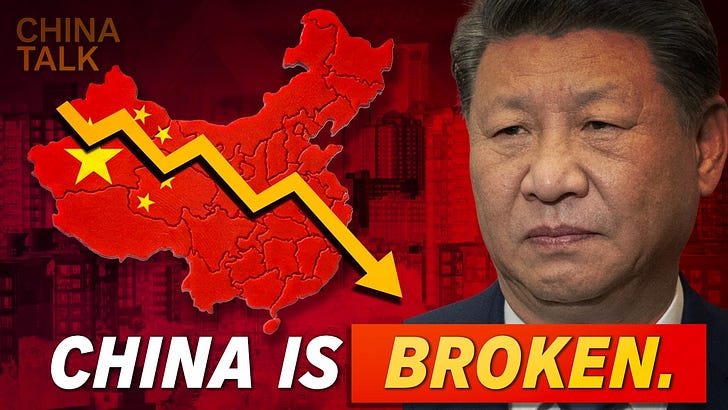
China's economy is not facing a crisis but a slow decay: the financial system that powered two decades of growth no longer works, and no one is willing to fix it.
An economy that is rotting
On 13 September 2021, protesters filled the lobby of Evergrande's headquarters. Staff had lent the company money and could not get it back. The biggest firm in China's most important industry had defaulted.
That is where Logan Wright's new book opens. His argument is that China's story is not collapse but decay: policy tools get blunter every year, yet nobody dares to actually restructure.
Where the money went
After the 2008 financial crisis, China ran the largest credit expansion any country has seen. In eight years, its bank assets grew by a third of global GDP.
Most of that money went into property and local infrastructure. When property collapsed in 2021, construction fell by 80% and sales by 60%. Nothing has replaced it.
Domestic demand cannot take up the slack, so exports have to. China's export competitiveness is largely a byproduct of collapsing internal demand — goods that cannot be sold at home get dumped abroad at lower prices.
The chosen industries cannot carry the load
EVs, AI data centres, robotics — add them all up, Wright says, and you get roughly 6.5% of GDP.
AI is not cheap either. China is spending about $135 billion on data centres this year, roughly a fifth of the US figure, while all frontier models together bring in $11 billion.
Meanwhile 12 to 13 million graduates a year are entering an economy that has not prepared jobs for them.
Wright puts it bluntly: if the domestic economy does not grow, industrial ambition can only be realised by taking export share from others. Taking from others means fighting them.
The only way out requires one man to change his mind
The fix looks like this: tax the wealthy, break up SOEs, unwind local government financing vehicles, top up pensions for migrant workers. The price is slower growth.
Xi does not believe in this. He believes something closer to the Soviet line: technology can route around markets, and AI will tell you how to allocate resources. Brezhnev thought the same.
Wright's conclusion: the model will not fall apart on its own, but external pressure will eventually force it to change. The question is when China finally feels enough pain.
Why it matters
The value of this conversation is not a forecast of collapse but a mechanism: when a country's financial system can no longer generate growth and cannot be restructured, every 'new industry' story is just life support for the old model. For Chinese policymakers, Washington and anyone with exposure to China, that frame matters more than any GDP number.


Curated from high-quality sources, with concise summaries and key takeaways.

